
Suspension & Ride-Height Sensor Diagnostics (2026 Pakistan Guide)
2026-11-29 10:03:59 · by MS Auto Tools
Suspension & Ride-Height Sensor Diagnostics: What Pakistani Workshops Need to Know in 2026
A car that sits low on one corner, a suspension warning light that will not go away, or a ride that has turned harsh overnight — these are the classic signs of a suspension or ride-height sensor fault. On modern Pakistani cars, from the Toyota Corolla and Honda Civic to the Kia Sportage and Hyundai Tucson, the suspension is no longer just springs and shock absorbers. Electronic ride-height sensors feed the car's computer every second, and when one of them fails, the car can lean, bounce, or even refuse to level itself. This guide explains how ride-height sensors work, the faults they develop, and how a workshop can diagnose them properly with a professional scanner in 2026.
What Is a Ride-Height Sensor and What Does It Do?
A ride-height sensor is a small electronic sensor mounted on the suspension, usually connected to a control arm by a short linkage rod. As the suspension moves up and down, the sensor measures the angle and sends a voltage signal to the suspension control module. The module uses that signal to know exactly how high each corner of the car sits above the road.
That information drives several systems at once. On cars with air suspension, such as the Toyota Land Cruiser, Audi models and many Mercedes-Benz cars seen on Pakistani roads, the module inflates or deflates the air springs to keep the car level. On cars with adaptive dampers, the module stiffens or softens the shock absorbers based on ride height and road conditions. The headlight levelling system also reads ride-height data so the headlights do not dazzle oncoming traffic when the car is loaded. Even the stability control system uses ride-height information to judge how the car is behaving in a corner.
Most cars have two to four ride-height sensors, one per corner or one per axle. A single faulty sensor can confuse the whole system, because the module compares all four corners against each other. If one corner reports a height that does not match the others, the module logs a fault and often disables the levelling function as a safety measure.
Common Symptoms of Suspension and Ride-Height Sensor Faults
The first symptom most drivers notice is uneven ride height. One corner sits visibly lower than the rest, or the car leans to one side when parked overnight. On an air-suspension car, the rear may sink after a few hours parked and then pump itself back up when the engine starts. That overnight sag is one of the most common complaints on Land Cruisers and older Mercedes models in Pakistan.
A suspension warning light or a "check suspension" message on the dashboard is the second clear sign. On Toyota and Lexus models, this often appears alongside a fault code in the C17xx range. On German cars, the message may read "air suspension fault" or "adaptive damping fault". The light means the control module has detected a reading it cannot trust, and it has usually switched the system to a safe default mode.
A harsh or bouncy ride is the third symptom. When the module loses reliable height data, it may lock the dampers in their firmest setting, making every pothole on a Lahore or Karachi road feel twice as bad. Some drivers describe it as the car suddenly riding like a truck. Others notice the opposite: the car floats and wallows because the dampers are stuck in their softest setting.
Other warning signs include the compressor running constantly, the car taking too long to rise after starting, headlights that point too high or too low, and a clunking noise from the sensor linkage area. A broken or seized linkage rod is a common mechanical failure, especially on cars that have spent years on rough rural roads or have been through flood water. The sensor itself may be fine, but if its linkage is bent or disconnected, the readings it sends are meaningless.
Why Pakistani Roads Make These Faults More Common
Pakistan's road conditions are hard on suspension electronics. Deep potholes, unmarked speed breakers and rough rural tracks put repeated shock loads through the sensor linkages. A single hard hit can bend a linkage rod or crack a sensor housing, and the fault may not appear until weeks later when corrosion sets in.
Water is the other enemy. During the monsoon season, cars in Karachi, Lahore and Islamabad routinely drive through standing water that reaches the sensor mounting points. Ride-height sensors sit low on the chassis, and their connectors are exposed. Water ingress corrodes the pins, and a corroded connector produces exactly the kind of erratic voltage signal that triggers false fault codes. Flood-damaged cars are the worst cases, with several sensors failing at once.
Dust and salt also take a toll. On the motorways and in coastal areas, fine dust works its way into sensor pivots until they seize. A seized sensor cannot follow the suspension movement, so it reports a fixed height while the car bounces around it. The module sees a height that never changes and logs a plausibility fault.
This is why a proper diagnostic approach matters. Replacing a sensor without checking the linkage, the wiring and the live data is guesswork, and at Rs 25,000 to Rs 80,000 per genuine sensor, guessing gets expensive fast.
How to Diagnose Ride-Height Sensor Faults Step by Step
A professional diagnosis follows a clear sequence. Skip a step and you risk replacing the wrong part.
Step 1: Read the fault codes. Connect a full-system scanner to the OBD2 port and read the suspension or chassis control module, not just the engine. Look for codes related to ride height, level control and suspension plausibility. Note the exact codes and whether they are current or stored. A stored code that does not return after clearing may have been caused by a one-off event, such as a hard pothole hit.
Step 2: Check the live data. With the scanner connected, open the live-data screen for the suspension module and watch the four ride-height sensor values while a helper pushes each corner of the car down and lets it rise. A healthy sensor shows a smooth, immediate change. A sensor that stays fixed, jumps in steps, or reads far outside the range of the other three is suspect. Compare all four corners at rest: on level ground, the readings should be close to each other.
Step 3: Inspect the hardware. Raise the car and look at each sensor and its linkage rod. Check for bent rods, broken clips, seized pivots and damaged wiring. Wiggle each connector and watch the live data for a flicker — a flickering reading points to a corroded or loose connector rather than a dead sensor. Check the sensor mounting bracket for cracks, especially on cars that have had suspension work done by an inexperienced mechanic.
Step 4: Test the compressor and air springs (air suspension cars only). If the car has air suspension, use the scanner's active test or bi-directional control function to command the compressor on and command each air spring to raise and lower. Listen for air leaks at the springs and valve block. A compressor that runs for more than 60 seconds without raising the car usually means a leak, not a sensor fault.
Step 5: Calibrate after repair. After replacing a sensor, linkage or air spring, the system almost always needs a ride-height calibration. The scanner guides this procedure: the car is placed on level ground, the actual ride height is measured, and the values are stored in the module. Skipping calibration is the most common reason a new sensor still shows a fault code. A basic code reader cannot do this — it needs a professional scanner with the calibration function for that make.
Which Scanner Functions Do You Actually Need?
Not every scanner can diagnose suspension systems. A basic OBD2 code reader only talks to the engine and will show nothing at all for a suspension fault. For this work, a workshop needs a full-system scanner with three capabilities: access to the chassis and suspension modules, live-data graphing for the ride-height sensors, and bi-directional control plus calibration functions.
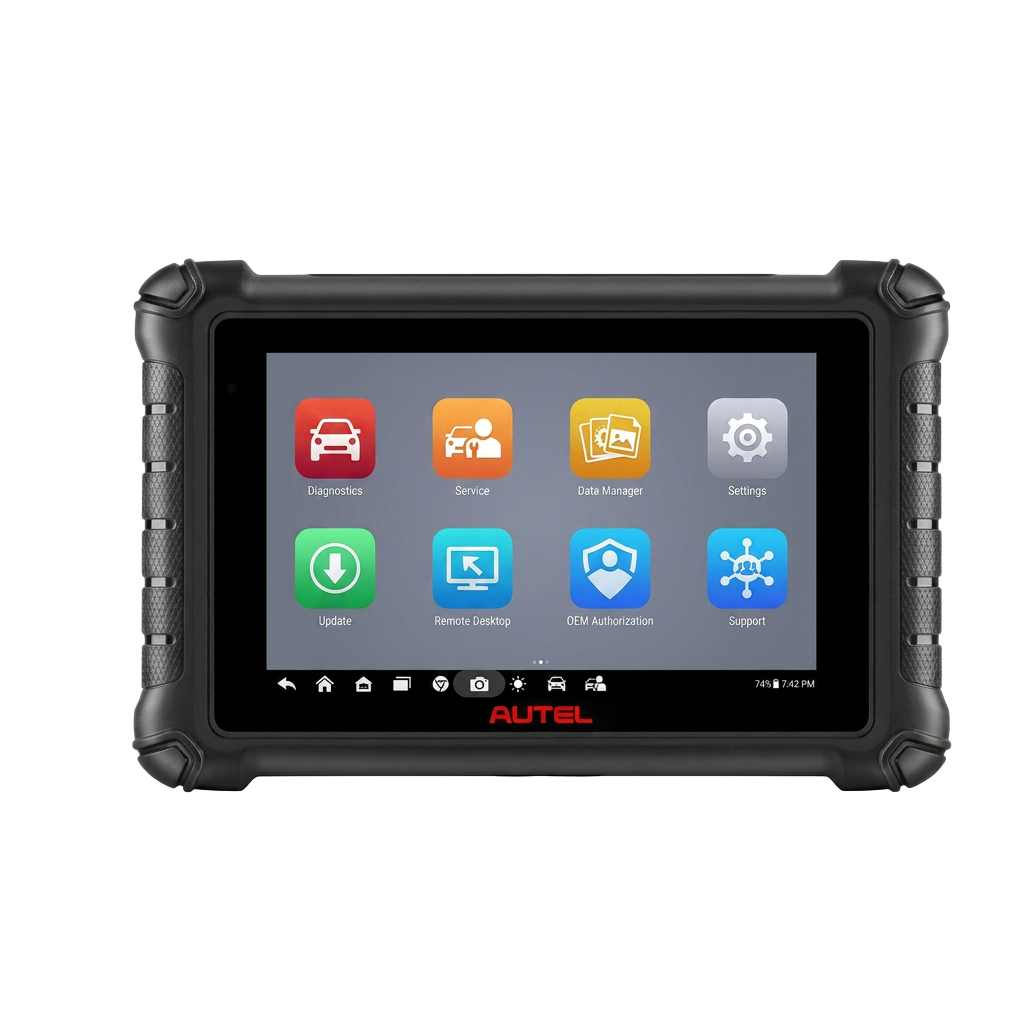
The Autel MaxiCheck MX900, at Rs 155,000, is a strong fit for this kind of work. It covers full-system diagnostics including suspension, air suspension and level control on Toyota, Honda, Suzuki, Kia, Hyundai and European makes, reads live ride-height data from all four corners, and supports the calibration and adaptation functions that a sensor replacement requires. It also handles CAN FD and DoIP, so it works on 2023 and newer models that older scanners cannot reach.
For larger workshops that see a heavy mix of European cars, the Launch X431 Pro V5.0 at Rs 290,000 adds deeper online coding and wider coverage, including advanced air-suspension functions on BMW, Mercedes-Benz and Audi. For a small workshop starting out, the Thinkdiag 2 at Rs 65,000 covers full-system diagnostics and live data on most common Pakistani models, though some calibration functions on premium cars may need a higher-end tool.
Whatever tool you choose, buy genuine. Counterfeit scanners are a serious problem in Pakistan: fake Autel and Launch tools sold online at suspiciously low prices often cannot access chassis modules at all, and some have been known to corrupt control-module software during calibration. A fake scanner that bricks a suspension module can turn a Rs 155,000 tool saving into a Rs 300,000-plus repair bill. MS Auto Tools sells 100 percent genuine tools with warranty — check the price, the seller and the warranty before you pay.
Common Fault Codes and What They Mean
Suspension fault codes vary by make, but the patterns are consistent. Toyota and Lexus use C1711 to C1714 for individual ride-height sensor circuit faults, one code per corner, and C1761 to C1764 for sensor range or performance problems. A C1711 on a Corolla Cross or Land Cruiser usually means the front-left sensor circuit is open or shorted — check the wiring before ordering a sensor.
German cars use their own numbering, but the descriptions are similar: "level sensor, front left, implausible signal" or "ride height, rear axle, out of range". On BMW and Mercedes models, a plausibility fault almost always means the sensor is reporting a value the module cannot believe, which is typically a seized linkage or a sensor that has slipped on its mounting.
On Korean cars such as the Kia Sportage and Hyundai Tucson, suspension faults often appear together with stability-control codes, because the two systems share the same height data. If a Sportage shows a suspension code and an ESC code at the same time, diagnose the suspension first — fixing the height sensor usually clears both.
A code that returns immediately after clearing, even with the car standing still, points to a hard electrical fault: a broken wire, a dead sensor or a corroded connector. A code that only appears while driving, especially over rough roads, points to a mechanical problem: a loose linkage, a worn pivot or a sensor that moves on its bracket.
What Does a Suspension Sensor Repair Cost in Pakistan in 2026?
Costs vary widely by car and by part. A ride-height sensor linkage rod costs Rs 3,000 to Rs 8,000 and takes under an hour to replace. A genuine ride-height sensor costs Rs 25,000 to Rs 80,000 depending on the make — Toyota sensors sit at the lower end, German sensors at the higher end. An air spring for a Land Cruiser or Mercedes costs Rs 60,000 to Rs 150,000 per corner, and a replacement compressor costs Rs 80,000 to Rs 200,000.
Diagnostic charges in Pakistani workshops typically run Rs 2,000 to Rs 5,000 for a full suspension scan with live-data analysis, and ride-height calibration after a repair adds Rs 3,000 to Rs 8,000. These are fair prices for work that needs a professional scanner and a technician who understands the system. Workshops that invest in the right tool and the calibration knowledge can charge confidently, because the customer can see the live data and the before-and-after ride heights on the screen.
For a workshop owner, suspension diagnostics is a profitable service to add. Air-suspension cars are now common in Pakistan, from Land Cruisers and Fortuners to Audi and Mercedes models, and very few workshops diagnose them properly. Most send the customer to the dealership, where the bill is often double. A workshop with an MX900 and the calibration know-how can keep that work in-house.
Preventing Suspension Sensor Faults
A few habits extend the life of ride-height sensors. Keep the sensor linkages clean and lightly lubricated during routine service, especially before the monsoon season. Avoid pressure-washing directly at the sensor connectors. After any suspension work — spring replacement, bush replacement, alignment — check that the sensor linkages were reconnected and the ride height is still correct. And after driving through deep water, have the underbody connectors inspected before corrosion sets in.
For drivers, the advice is simpler: do not ignore a suspension warning light. Driving for weeks with a faulty height sensor wears the tyres unevenly, overloads one air spring, and can burn out the compressor from constant running. A Rs 5,000 diagnostic today can prevent a Rs 150,000 compressor replacement next month.
If your workshop is seeing more suspension warning lights this year, you are not alone. As Pakistan's car fleet gets newer and more electronic, ride-height sensors are becoming a routine diagnostic job rather than a rare one. The workshops that learn the system now — live data, linkage checks, proper calibration — will own this work for years.
For genuine diagnostic tools with warranty and Pakistan-wide delivery, contact MS Auto Tools on WhatsApp at +92 300 0678111. Our team can help you choose the right scanner for the cars your workshop actually sees, from the Thinkdiag 2 at Rs 65,000 for everyday full-system work to the Autel MaxiCheck MX900 at Rs 155,000 for suspension calibration and CAN FD coverage.
Frequently Asked Questions
Q1: Can a faulty ride-height sensor cause the car to lean to one side?
Yes. The suspension control module relies on the sensor to know each corner's height. If a sensor reports the wrong height, the module may inflate or deflate the wrong air spring, or it may disable levelling entirely, leaving the car sitting low or leaning on the faulty corner.
Q2: Can I drive with a suspension warning light on?
You can drive short distances at low speed, but it is not safe to ignore. The system is usually in a default mode with reduced stability control, the ride may be harsh, and a faulty sensor can cause the compressor to run constantly and burn out. Get it diagnosed within a few days.
Q3: Does replacing a ride-height sensor need calibration?
In almost all cases, yes. After fitting a new sensor, the control module must learn the correct ride height on level ground through a calibration procedure. Without calibration, the new sensor will usually still show a fault code. This needs a professional scanner with the calibration function for that make.
Q4: Why does my Land Cruiser sink overnight but rise again in the morning?
This is usually a slow air leak in a rear air spring or valve block, not a sensor fault. The car sinks as air escapes overnight, then the compressor pumps it back up when you start the engine. A smoke or soapy-water leak test, plus a scanner active test of each air spring, will find the leak.
Q5: Will a basic OBD2 scanner diagnose suspension faults?
No. Basic code readers only communicate with the engine control module. Suspension faults live in the chassis or suspension control module, which needs a full-system scanner such as the Autel MaxiCheck MX900 at Rs 155,000 or the Thinkdiag 2 at Rs 65,000.
Q6: How do I know if the fault is the sensor or just the linkage rod?
Watch the live data while moving the suspension by hand. If the sensor value changes smoothly, the sensor is fine and the problem is likely the linkage, wiring or calibration. If the value stays fixed or jumps in steps while the suspension moves, the sensor itself is faulty. A visual check of the linkage rod often shows the answer: bent rods and broken clips are common after hard pothole hits.