
O2 Sensor Faults: Fuel Trim, Emissions & Fuel Economy (2026 Pakistan Guide)
2026-11-26 10:00:26 · by MS Auto Tools
O2 Sensor Faults: Fuel Trim, Emissions & Fuel Economy (2026 Pakistan Guide)
If your customer's Corolla is suddenly drinking petrol like a Land Cruiser, the check engine light is on, and the car smells of raw fuel at idle, there is a good chance the oxygen sensor is lying to the ECU. O2 sensor faults are among the most common reasons Pakistani cars fail emissions checks, waste fuel, and lose power — and they are also among the cheapest to diagnose correctly once you understand fuel trim. This guide explains what O2 sensors do, how to read fuel trim numbers on a scanner, the symptoms of a failing sensor, and the step-by-step fix that workshops in Pakistan should follow in 2026.
What Is an O2 Sensor and Why Does It Matter?
An oxygen sensor, also called a lambda sensor, sits in the exhaust and measures how much oxygen is left in the burnt gases. The engine control unit (ECU) uses that reading to adjust the air-fuel mixture hundreds of times per second. A healthy petrol engine wants a ratio of about 14.7 parts air to 1 part fuel. When the sensor reports accurately, the ECU holds that ratio, fuel economy stays good, and the catalytic converter can clean the exhaust properly.
Most modern Pakistani cars — Toyota Corolla, Honda Civic, Suzuki Swift, Kia Sportage, Hyundai Tucson — carry two O2 sensors: an upstream sensor before the catalytic converter that controls the mixture, and a downstream sensor after it that monitors converter efficiency. When either one drifts, gets slow, or dies, the ECU starts guessing. That guessing costs your customer money at the petrol pump every single day.
How Fuel Trim Tells You the O2 Sensor Is Lying
Fuel trim is the ECU's correction to the base fuel map, shown as a percentage. Short-term fuel trim (STFT) reacts instantly; long-term fuel trim (LTFT) is the learned correction over time. On a healthy car at idle and at cruise, both should sit within plus or minus 5 percent. Between 5 and 10 percent is a warning. Beyond plus or minus 10 percent, something is wrong, and beyond 25 percent the ECU will usually set a fault code and light the check engine lamp.
A positive fuel trim means the ECU is adding fuel because the sensor says the mixture is lean. A negative trim means it is pulling fuel out because the sensor says the mixture is rich. The trick is that a bad O2 sensor can fake both directions. A lazy upstream sensor that responds slowly makes the trim swing wildly — plus 12 percent one second, minus 8 the next. A dead sensor stuck at a fixed voltage makes the trim freeze at a large correction. A good scanner shows you live STFT, LTFT, and O2 sensor voltage on one screen, which is exactly how a professional diagnoses this fault instead of guessing and changing parts.
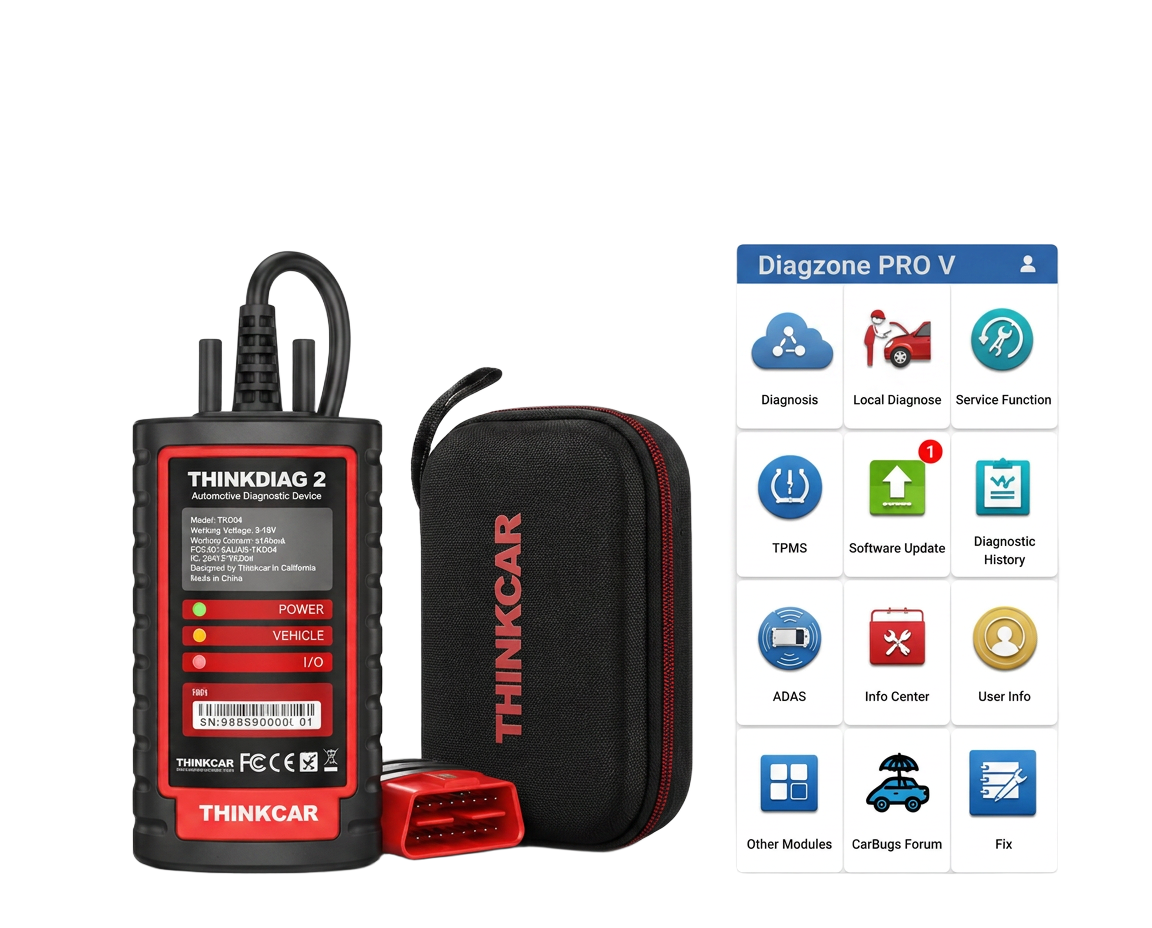
On the Thinkdiag 2 Diagzone Pro, available at MS Auto Tools for Rs 65,000, you can graph the upstream O2 sensor voltage in real time. A healthy sensor switches between roughly 0.1 and 0.9 volts several times per second. If the trace is flat, slow, or stuck, the sensor is finished — no matter what the fault code says.
Common O2 Sensor Fault Codes in Pakistan
Pakistani workshops see the same handful of codes again and again. P0130 to P0135 cover the upstream sensor circuit and heater on bank 1. P0136 to P0141 cover the downstream sensor. P0171 means system too lean on bank 1, and P0172 means system too rich — both are often O2-related, but they can also be caused by vacuum leaks, weak fuel pumps, or dirty injectors, so the code alone is never the diagnosis.
P0420 and P0430, catalytic converter efficiency below threshold, are frequently triggered by a lazy downstream sensor rather than a dead converter. Replacing a converter that costs Rs 80,000 to Rs 150,000 when the real fault is a Rs 12,000 sensor is one of the most expensive mistakes a workshop can make. Always check the downstream sensor's switching speed before condemning the converter.
Symptoms Your Customers Actually Notice
The customer rarely walks in saying "my O2 sensor is faulty". They say the car is using too much petrol. A Corolla that used to give 13 km per litre in the city and now gives 9 is a classic O2 sensor story. Other symptoms include a rough or hunting idle, hesitation when accelerating, a strong petrol smell from the exhaust, black smoke on hard acceleration, and the engine taking longer to start on cold mornings.
On cars running on CNG, a failing O2 sensor causes even more trouble, because the ECU's fuel corrections fight the CNG kit's own adjustments. If a CNG-converted Civic keeps stalling at signals or jerking at low speed, check the O2 sensor and fuel trim before touching the CNG kit.
Why O2 Sensors Fail Early on Pakistani Roads
Oxygen sensors are consumables, but in Pakistan they often fail earlier than the 100,000 km the manufacturer expects. The biggest killer is contaminated fuel — adulterated petrol with excess sulphur or additives coats the sensor tip and slows its response. Leaded fuel, still occasionally found at unreliable pumps, poisons the sensor permanently. Oil burning from worn valve seals coats the sensor in carbon. Coolant leaking into the exhaust from a failing head gasket coats it in silicates. And on flood-damaged or deep-water-driven cars, thermal shock from cold water hitting a hot sensor cracks the ceramic element.
This is also why a cheap counterfeit sensor is a false economy. Fake O2 sensors sold in the grey market often use a low-grade element that switches slowly from day one. The ECU sees the slow switching, sets a code, and the customer is back in your workshop within a week — angry, and blaming you. MS Auto Tools supplies only genuine diagnostic tools and sensors with warranty, and the same rule applies to parts: fit a genuine sensor, or a known-quality brand, and the job stays fixed.
Step-by-Step O2 Sensor Diagnosis for Workshops
Start with a full scan and record the freeze-frame data — the code, the fuel trim values, and the engine temperature at the moment the fault was set. A code set at cold start points somewhere different from one set at highway cruise. Next, look at live data: graph the upstream O2 sensor voltage and watch the switching frequency. A healthy sensor crosses 0.45 volts at least 8 to 10 times in 10 seconds at 2,500 rpm. Fewer crossings means a lazy sensor.
Then check STFT and LTFT at idle and at 2,500 rpm. High positive trim at idle that improves at higher rpm points to a vacuum leak, not the sensor. High trim at all speeds points to a fuel delivery problem or a lying sensor. Compare the downstream sensor too — it should switch slowly and stay mostly steady around 0.6 to 0.8 volts. If it mirrors the upstream sensor exactly, the catalytic converter is not working, or the downstream sensor itself is faulty.
Check the heater circuit with a multimeter before ordering a sensor. A heater fault code (P0135) is often a blown fuse, a corroded connector, or a broken wire — not the sensor. Finally, inspect the exhaust for leaks ahead of the sensor. Even a small leak at the manifold gasket pulls in fresh air and makes the sensor read lean, sending fuel trim sky-high for no reason.
If you need a scanner that graphs O2 voltage and fuel trim live, the Thinkdiag 2 Diagzone Pro (Rs 65,000 at MS Auto Tools) covers full-system diagnostics, live data graphing, and service functions on Corolla, Civic, Swift, Sportage, Tucson, and most other cars on Pakistani roads. WhatsApp us on +92 300 0678111 for current stock and delivery anywhere in Pakistan.
Replacing the Sensor: What to Get Right
Always replace with the correct sensor for the car — upstream and downstream sensors are different parts with different connectors and heater resistances, and they are not interchangeable. Use a proper O2 sensor socket, not an open spanner, so you do not crack the new sensor. Apply the anti-seize compound supplied with the sensor only to the threads, never to the tip. Torque to the manufacturer's figure, usually around 40 to 50 Nm, and route the wiring exactly as the old sensor was routed, away from hot exhaust parts.
After fitting, clear the codes, reset the fuel trim adaptations with your scanner, and take the car for a proper drive cycle — city driving plus a few minutes at steady highway speed — so the ECU relearns. Recheck STFT and LTFT afterwards: both should be back inside plus or minus 5 percent. If the trim is still high, the sensor was not the only problem, and you need to keep diagnosing instead of handing the car back.
O2 Sensors, Emissions Tests, and Fuel Economy
With emission testing slowly becoming a reality in Lahore, Karachi, and Islamabad, O2 sensor health is moving from a fuel-economy issue to a legal one. A car with a dead O2 sensor will fail any proper emissions test because the mixture is wrong and the catalytic converter cannot do its job. Workshops that can show a customer a before-and-after fuel trim graph have a powerful sales tool: the numbers prove the repair worked, and the customer can feel the difference in their fuel bill.
The maths is simple. A Corolla doing 12,000 km a year at 9 km per litre instead of 13 uses about 410 extra litres of petrol. At 2026 petrol prices that is roughly Rs 100,000 a year wasted — against a sensor and labour bill of a fraction of that. When you explain it this way, the customer stops seeing the repair as a cost and starts seeing it as a saving.
Frequently Asked Questions
How long does an O2 sensor last in Pakistan?
A genuine sensor typically lasts 80,000 to 100,000 km. Contaminated fuel, oil burning, and coolant leaks can cut that to 40,000 to 60,000 km. If the car is over 100,000 km and fuel economy has dropped, the sensor is a prime suspect.
Can I drive with a faulty O2 sensor?
For a short distance, yes, but it is not wise. The ECU runs rich to protect the engine, which wastes fuel, fouls spark plugs, and can overheat and destroy the catalytic converter — turning a Rs 12,000 sensor job into a Rs 100,000 converter replacement.
Why does my fuel trim stay high after replacing the sensor?
Because the sensor was not the only problem. Check for vacuum leaks, a weak fuel pump, dirty injectors, a faulty MAF sensor, or an exhaust leak before the sensor. Also confirm the fuel trim adaptations were actually reset with a scanner after the repair.
Does a P0420 code always mean the catalytic converter is dead?
No. A lazy downstream O2 sensor triggers P0420 just as easily. Compare the upstream and downstream sensor graphs first. If the downstream sensor switches as fast as the upstream one, test the sensor before condemning the converter.
Which scanner shows fuel trim and O2 sensor graphs?
Any professional scanner with live data graphing. The Thinkdiag 2 Diagzone Pro (Rs 65,000) graphs O2 voltage and fuel trim in real time and covers full-system diagnostics on most cars in Pakistan. For a workshop-grade tablet, the Autel MaxiCheck MX808S (Rs 148,000) offers the same live data with a larger screen and faster processing.
Can a bad O2 sensor cause a failed emissions test?
Yes. A faulty sensor makes the engine run rich or lean, which pushes hydrocarbons and carbon monoxide far above test limits. Fixing the sensor and resetting adaptations is the first step before any emissions retest.
Conclusion
O2 sensor faults are common, cheap to diagnose properly, and expensive to ignore. Learn to read fuel trim, graph the sensor voltage, and check the heater circuit before ordering parts — and you will stop replacing converters that were never broken. A genuine sensor, fitted correctly and verified with live data, restores fuel economy, clears the check engine light, and keeps your customer coming back to your workshop instead of the one down the road.
If your workshop needs a scanner that reads fuel trim and O2 sensor live data properly, talk to MS Auto Tools on WhatsApp +92 300 0678111. The Thinkdiag 2 Diagzone Pro is Rs 65,000 with 2 years of free updates, genuine with warranty, and delivered anywhere in Pakistan. Order today and stop guessing at O2 sensor faults.