Fuel Pump & Fuel Pressure Diagnostics for Workshops (2026 Pakistan Guide)
2026-11-07 18:00:25 · by MS Auto Tools
# Fuel Pump & Fuel Pressure Diagnostics for Workshops (2026 Pakistan Guide)
Fuel pressure is the one number that separates a guess from a diagnosis. When a Corolla cranks but won't start, a Civic hesitates under load, or a Sportage loses power on the motorway, the fuel pump and fuel pressure are among the first things a professional workshop should check — before touching injectors, coils, or the ECU. This guide explains how fuel pump and fuel pressure diagnostics actually work, the tools you need, the pressure values for common Pakistani cars, and the step-by-step workflow your workshop can use in 2026.
## What Is Fuel Pressure and Why Does It Matter?
Fuel pressure is the force with which the fuel pump pushes petrol or diesel from the tank to the injectors. The engine control unit (ECU) expects a very specific pressure range. If pressure is too low, the engine runs lean — it misfires, hesitates, stalls, or refuses to start. If pressure is too high, the engine runs rich — fuel consumption jumps, the exhaust smells of petrol, and the catalytic converter takes damage.
In most modern petrol cars in Pakistan, the electric fuel pump sits inside the fuel tank. It is powered the moment you turn the key, builds pressure in the fuel rail, and a pressure regulator keeps that pressure steady. On a Toyota Corolla Grande, normal fuel rail pressure is roughly 300–350 kPa (about 43–51 psi). On a Honda Civic 1.8, expect around 340–400 kPa. Diesel cars like the Toyota Fortuner 2.8 work very differently — their high-pressure pump can push diesel past 1,800 bar in the common rail — so diesel pressure testing needs a scanner that reads live rail pressure, not a mechanical gauge.
## Common Symptoms of a Failing Fuel Pump
Fuel pump failure rarely happens without warning. Watch for these signs, and teach your customers to report them early:
**1. Long cranking before the engine starts.** The pump is weak and takes several seconds to build pressure — the most common early symptom in high-mileage Corollas and Civics.
**2. Engine sputtering at high speed.** The car drives fine around town but jerks or loses power above 100 km/h. The pump cannot keep up with demand at high RPM.
**3. Loss of power under load.** Climbing a hill or overtaking with the AC on makes the engine stumble. Fuel demand rises under load, and a tired pump falls behind.
**4. Engine surging at steady speed.** The car speeds up and slows down on its own at a constant throttle position — a classic sign of unstable fuel pressure.
**5. Sudden stalling, then restarting after a few minutes.** A dying pump overheats, cuts out, cools down, and works again briefly. Customers often describe this as "the car just dies, then starts after 10 minutes."
**6. Whining or buzzing from the fuel tank.** A healthy pump makes a soft hum for 2–3 seconds when you turn the key to ON. A loud, high-pitched whine means the pump motor is wearing out.
**7. No-start with spark and air confirmed.** If the engine cranks, has spark, and the air filter is clean, fuel delivery is the next thing to prove — and pressure testing proves it in minutes.
## Tools You Need for Fuel Pressure Diagnostics
A workshop that wants to diagnose fuel problems properly needs three things:
**A mechanical fuel pressure gauge kit.** This connects to the Schrader valve on the fuel rail (where fitted) and shows real pressure in psi or kPa. A decent kit costs Rs 8,000–15,000 in Pakistan and pays for itself in a week. Always relieve pressure before disconnecting, and keep a fire extinguisher nearby — you are working with pressurised petrol.
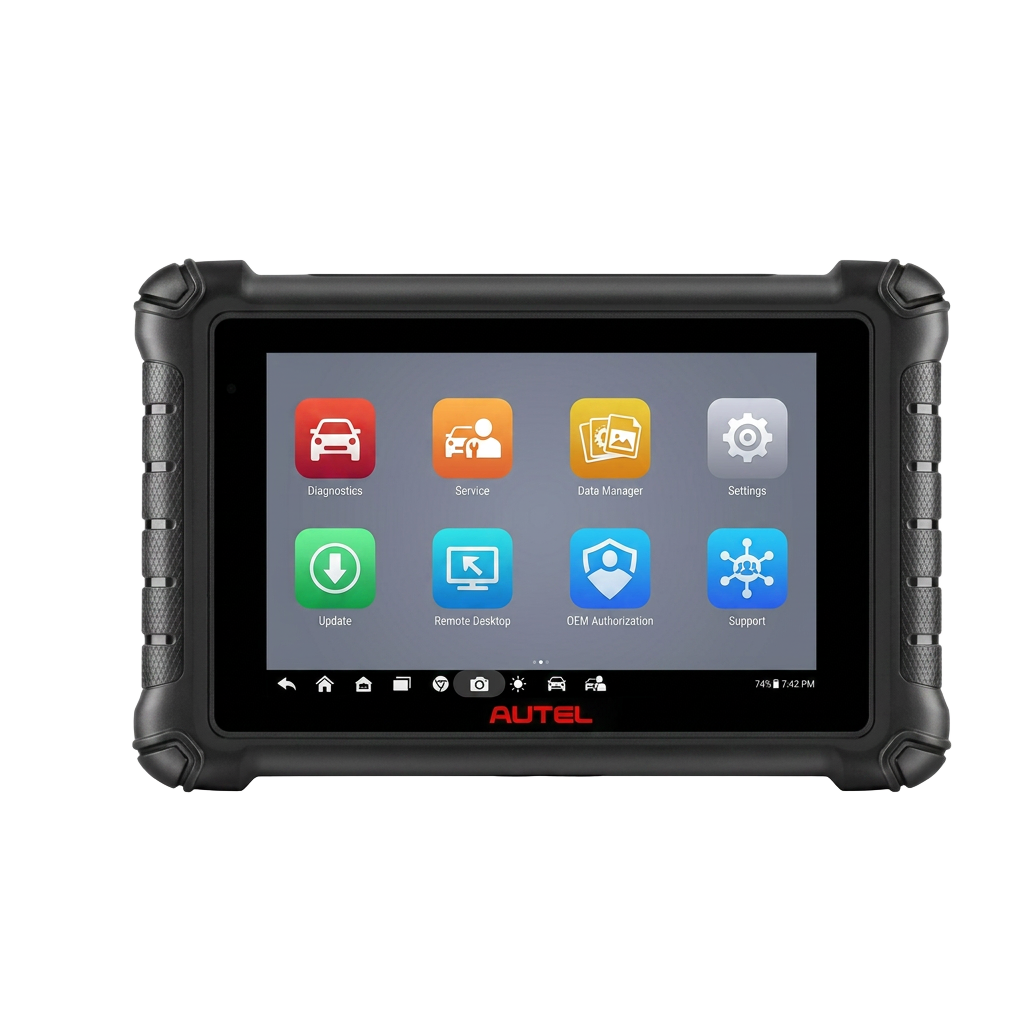
**A professional OBD2 scanner with live data.** This is where the real diagnostic power sits. A scanner reads fuel rail pressure directly from the sensor, shows fuel trim values, fuel pump command status, and lets you activate the fuel pump through bi-directional control. The Autel MaxiCheck MX900 (Rs 155,000 at MS Auto Tools) reads live fuel pressure on most Pakistani cars, supports DoIP and CAN FD for 2023+ models, and runs active tests including fuel pump activation — so you can command the pump on and watch pressure build without cranking the engine.
**A multimeter (optional but valuable).** Voltage drop across the pump circuit tells you whether the problem is the pump or the wiring, relay, and fuse feeding it. A pump drawing too much current is on its way out; one drawing nothing has an open circuit.
**A word of warning about counterfeit tools:** cheap copy scanners and fake Autel or Launch devices are common in Pakistani markets. They show wrong live data, miss fuel pressure PIDs entirely, and some have even corrupted ECUs during active tests. Buy genuine tools with warranty from an authorised seller — a wrong fuel pressure reading can send you replacing a perfectly good pump.
## Step-by-Step Fuel Pressure Test (Petrol Cars)
Follow this workflow on any petrol car — Corolla, Civic, Swift, City, Yaris — and you will find the fault instead of guessing at it.
**Step 1: Scan first, wrench second.** Connect your scanner and read fault codes. Codes like P0087 (fuel rail pressure too low), P0088 (pressure too high), P0171 (system too lean), P0230 (fuel pump primary circuit) or P0190 (fuel rail pressure sensor circuit) point straight at the fuel system. Record freeze-frame data — it shows the exact conditions when the code set.
**Step 2: Listen for the pump prime.** Turn the key to ON (engine off). You should hear the pump hum for 2–3 seconds. No sound? Check the fuel pump fuse and relay first — a Rs 500 relay is a much cheaper fix than a Rs 25,000 pump.
**Step 3: Connect the pressure gauge.** Attach the gauge to the fuel rail test port. On cars without a test port (many newer models), use a T-fitting in the fuel line or rely on the scanner's live rail pressure reading.
**Step 4: Key ON, engine OFF pressure.** With the key on and the engine off, pressure should jump to the specified range within 2–3 seconds and hold. On a Corolla, that is roughly 300–350 kPa. If pressure is low or zero, the pump, its filter, or its power supply is suspect.
**Step 5: Check pressure hold (leak-down test).** Turn the key off and watch the gauge for 5 minutes. Pressure should hold steady or drop only slightly. A rapid drop points to a leaking injector, a faulty check valve in the pump, or a bad pressure regulator.
**Step 6: Running pressure and volume.** Start the engine. Pressure should stay in range at idle and under load. Then do a volume test: a healthy pump should deliver roughly 500 ml of fuel in 15–30 seconds. Low volume with normal pressure still means a failing pump — pressure alone does not tell the whole story.
**Step 7: Check fuel trim on the scanner.** Long-term fuel trim above +10% means the ECU is adding fuel to compensate for a lean condition — often low fuel pressure. Combined with a low pressure reading, the diagnosis is confirmed.
**Step 8: Test the electrical side.** Measure voltage at the pump connector while the pump runs. It should be within 0.5V of battery voltage. A bigger drop means corroded wiring, a bad relay, or a failing ground — common on older cars and on cars with CNG conversions that disturb the original wiring.
## Fuel Pressure Specifications for Popular Pakistani Cars
Use these as starting points — always confirm against the manufacturer's service data for the exact model year:
- **Toyota Corolla (1.6 / 1.8, 2014–2026):** 300–350 kPa (43–51 psi)
- **Honda Civic (1.5 Turbo / 1.8, 2016–2026):** 340–400 kPa (49–58 psi)
- **Honda City (1.2 / 1.5):** 300–350 kPa (43–51 psi)
- **Suzuki Swift (1.2):** 290–320 kPa (42–46 psi)
- **Kia Sportage / Hyundai Tucson (2.0 petrol):** 340–380 kPa (49–55 psi)
- **Toyota Fortuner 2.8 diesel (common rail):** 250–1,800 bar live rail pressure, read via scanner only
- **Suzuki Alto / Cultus:** 280–320 kPa (41–46 psi)
If your reading is more than 10% outside the range, something is wrong. Do not adjust anything — find the cause first.
## Diesel Fuel Pressure: A Different Game
Diesel common-rail systems run at pressures 50 times higher than petrol systems, and you cannot test them with a mechanical gauge. Everything is done through the scanner: live rail pressure at idle (typically 250–350 bar), pressure under load (up to 1,600–1,800 bar on a Fortuner or Hilux), and injector correction values that show which cylinder is over- or under-fuelling.
Low rail pressure on a diesel usually means a worn high-pressure pump, a faulty pressure regulator valve, leaking injectors, or a clogged fuel filter — and in Pakistan, contaminated diesel is a frequent cause. Always change the fuel filter first; it is the cheapest fix and solves the problem more often than customers expect.
## The Right Scanner Makes Fuel Diagnostics Profitable
Fuel pressure work is one of the highest-margin diagnostic services a workshop can offer, because the test takes 15 minutes and the answer is definitive. But it only works if your scanner reads live fuel pressure accurately and can activate the pump on demand. The Autel MaxiCheck MX900 (Rs 155,000) does both, covers all major Pakistani car brands, and handles CAN FD and DoIP protocols on newer models that older scanners cannot even connect to. For smaller workshops, the Launch DBScar VII (Rs 75,000) is a solid Bluetooth option with full live data including fuel rail pressure. Either way, invest in a genuine tool — fuel diagnostics built on wrong data will cost you far more in comebacks than the tool ever cost. In Pakistan in 2026, a proper fuel pressure diagnostic — scan, gauge test, leak-down test and a written report — is fairly priced at Rs 2,000–4,000. Fuel pump replacement labour is typically Rs 3,000–6,000, plus the pump itself: a genuine Corolla fuel pump assembly costs roughly Rs 18,000–35,000, while a Civic pump runs Rs 25,000–45,000.
**Ready to add fuel pressure diagnostics to your workshop?** Message MS Auto Tools on WhatsApp at +92 300 0678111 for genuine Autel and Launch scanners with warranty, Pakistan-wide delivery, and guidance on which tool fits your workshop.
## Frequently Asked Questions
**How do I know if my fuel pump is failing or my fuel filter is clogged?**
Both cause low pressure, but a clogged filter usually causes problems only under load, while a failing pump struggles even at idle and during priming. A volume test separates them: low volume with a new filter means the pump is dying. Always replace the filter first — it is the cheaper part.
**What fuel pressure should a Toyota Corolla have?**
A Corolla 1.6 or 1.8 should show roughly 300–350 kPa (43–51 psi) at the fuel rail with the key on and the engine off, and hold that pressure while running. Readings below 280 kPa indicate a fuel delivery problem.
**Can a bad fuel pump cause a check engine light?**
Yes. Low fuel pressure triggers codes like P0087 (fuel rail pressure too low) and P0171 (system too lean), and the check engine light comes on. A scanner will show both the code and the live pressure reading that proves the cause.
**How long does a fuel pump last in Pakistan?**
A genuine fuel pump typically lasts 150,000–200,000 km, but Pakistani conditions — low fuel levels, contaminated petrol, and heat — can shorten that to 100,000 km. Running the tank below a quarter regularly overheats the pump, because fuel cools it.
**Can I test fuel pressure without a gauge?**
Yes, partly. A professional scanner reads live fuel rail pressure from the car's own sensor on most models, and bi-directional control lets you activate the pump to watch pressure build. A gauge is still useful for cars without a rail pressure sensor or a test port, but the scanner covers most modern cars.
**Is it safe to drive with a failing fuel pump?**
No. A failing pump can stall the engine without warning — on a motorway, that is dangerous. It can also damage the catalytic converter by making the engine run lean. Get it tested as soon as symptoms appear, and do not ignore long cranking or power loss under load.
---
*Need a genuine diagnostic scanner for your workshop? MS Auto Tools stocks genuine Autel, Launch, Xhorse, Thinkcar, OBDSTAR and XTOOL tools with warranty and delivery across Pakistan. WhatsApp us at +92 300 0678111 — tell us your workshop's car mix and we will recommend the right tool.*