Flood-Damaged Car Diagnostics: ECUs, Wiring & What to Check First (2026 Pakistan Guide)
2026-11-28 10:04:26 · by MS Auto Tools
A flood-damaged car can look perfectly fine on the outside and be dying on the inside. After the heavy monsoon rains that hit Karachi, Lahore and Islamabad in recent years, thousands of water-damaged cars entered the used-car market in Pakistan — many of them cleaned, dried and sold without a word about their history. The danger is not the wet carpets. It is what water does to the car's electronics: the engine control unit (ECU), the airbag module, the body control module, the wiring harness and every connector under the floor. Water plus electricity plus time equals corrosion, and corrosion causes faults that appear weeks or months after the flood, long after the sale is done. This guide explains how to diagnose a flood-damaged car properly in 2026 — what to check first, which fault codes matter, which tools to use, and when a car is worth saving and when it is not.
Why Flood Damage Is an Electronics Problem First
Modern cars are computers on wheels. A Toyota Corolla, Honda Civic, Suzuki Swift, Kia Sportage or Hyundai Tucson built after 2018 carries 20 to 40 electronic control modules connected by CAN bus wiring, and most of those modules sit low in the car — under the seats, behind the kick panels, under the floor carpet, in the boot. When flood water rises above the door sills, it reaches the wiring first. Fresh rainwater is a poor conductor, but flood water in Pakistani cities is never fresh: it carries mud, sewage, salt and chemicals, and that mixture is highly conductive and highly corrosive.
The damage happens in three stages. First, while the car is still wet, water bridges circuits that should never touch, blowing fuses, shorting modules and sometimes killing an ECU outright. Second, as the car dries, minerals and salts are left behind on circuit boards and connector pins, and corrosion begins — green and white crust on terminals, blackened copper, pins that crumble when touched. Third, months later, the corrosion spreads through the wiring harness, causing intermittent faults: a car that starts fine in the morning and stalls at noon, an airbag light that comes and goes, a gearbox that shifts harshly only on hot days. This is why a flood car that "runs fine" at the time of sale can become a nightmare six months later, and why a proper diagnostic scan before buying or repairing is worth far more than a visual inspection.
The 10-Minute First Inspection: Water Lines, Smell and Silt
Before connecting any tool, do a physical inspection that takes ten minutes and tells you how deep the water went. Start with the water line: look for a faint horizontal dirt or silt line on the inside of the doors, on the seat frames, on the boot walls and on the plastic trim under the dashboard. On a Corolla or Civic, pull the front seat belt all the way out — a brown tide mark on the belt webbing is one of the hardest things for a seller to hide. Check under the carpets: lift a corner of the front footwell carpet and feel the sound-deadening foam underneath. If it is damp, heavy or smells of stagnant water, the car took water above sill level.
Smell matters more than most buyers realise. A flood car smells of damp, mud and mildew even after professional cleaning, especially when the heater is switched on. Check the spare wheel well in the boot, where water pools and is rarely cleaned properly, and look for silt or sand in the door pockets, the glovebox hinges and the air vents. Look at the headlights and tail lights from the side: condensation or a water line inside a sealed lamp means the car was submerged at least to that height. Finally, check the engine bay for a silt line on the inner wings and the fuse box lid, and look at the oil dipstick — milky, coffee-coloured oil means water got into the engine, which is a different and much more serious problem than wet electronics.
Never try to start a car that has been sitting in flood water without checking first. If water entered the engine through the air intake, cranking it can bend connecting rods — a condition called hydrolock — and turn a repairable car into a scrap engine. Remove the air filter and check it for dampness, check the engine oil for the milky colour, and if there is any doubt, do not crank the engine until a mechanic has checked it.
The Full-System Scan: The Single Most Important Step
After the physical inspection, the next step is a full-system diagnostic scan — not just a check-engine-light read, but a scan of every module in the car. This is the step that separates a guess from a diagnosis, and it is the step a cheap code reader cannot do. A proper diagnostic scanner talks to the engine ECU, the transmission control module, the ABS module, the airbag (SRS) module, the body control module, the instrument cluster, the steering module and the climate control, and reports which modules answer and which do not.
A module that does not answer at all is the biggest red flag in flood diagnostics. It usually means the module is dead, its power supply is corroded, or its CAN bus connection is broken. On a flood car, expect to see communication fault codes — U-codes such as U0100 (lost communication with ECM), U0121 (lost communication with ABS module) and U0155 (lost communication with instrument cluster). One or two U-codes can be a single dead module. Five or six U-codes across different systems usually mean the CAN bus wiring itself is corroded, which is a much bigger repair.
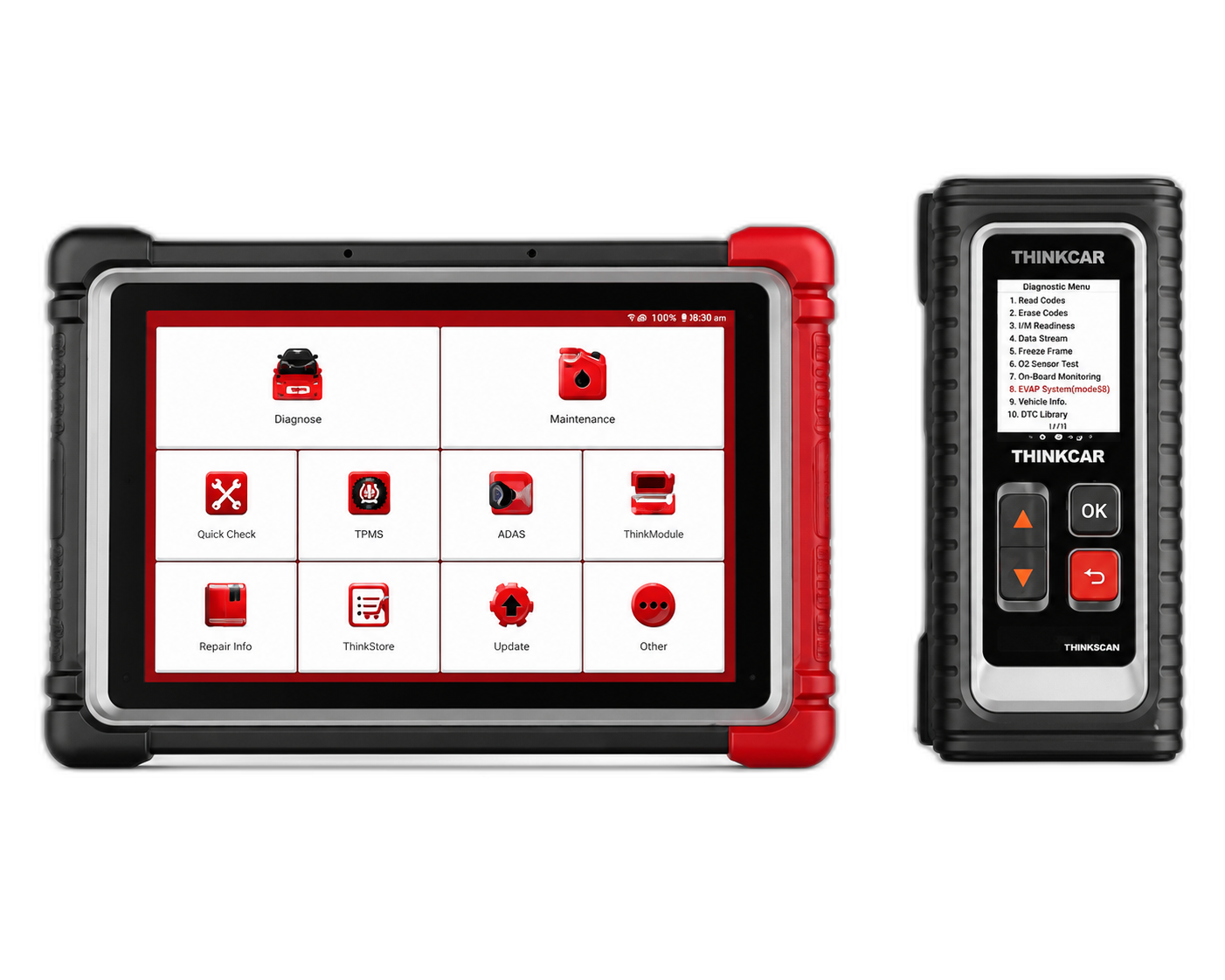
For this job, workshops in Pakistan use an OE-level scanner such as the THINKCAR-THINKTOOL Expert 195, available from MS Auto Tools for Rs 250,000 in 2026 (down from Rs 290,000). It performs full-system scans on Toyota, Honda, Suzuki, Kia and Hyundai, reads live data from every module, and supports the online coding and module programming that flood repairs often need. For a smaller workshop or a pre-purchase inspection, the Thinkdiag 2 at Rs 65,000 or the Launch DBScar VII at Rs 75,000 covers full-system scanning on the same cars at a lower price. Whatever tool you use, save the scan report before clearing any codes — the original fault list is evidence of what the flood actually damaged.
What to check on WhatsApp before you spend a rupee: message MS Auto Tools on WhatsApp at +92 300 0678111 with the car's make, model and year, and ask which scanner covers a full-system scan for that exact car. Genuine tools with warranty are the only safe buy — counterfeit scanners sold online often cannot communicate with airbag or transmission modules at all, and a scanner that misses a dead SRS module can leave a buyer driving a car whose airbags will never deploy.
Reading the Fault Codes: Which Ones Matter and Which Do Not
A flood car will usually show a long fault list, and not every code is equally serious. Learn to sort them into three groups. Group one is fatal: airbag module communication failure, ECU internal fault, immobiliser or key-system faults that prevent starting, and any code that says a module is not responding. A dead airbag module is not just an expensive repair — it is a safety failure, and a car with a non-communicating SRS module should not be driven until it is fixed.
Group two is repairable but expensive: transmission control faults, ABS pump and sensor faults, body control module faults affecting windows, locks and lights, and steering angle sensor faults. Each is usually a single module or a connector. Group three is cosmetic or secondary: climate control, parking sensor, seat memory and infotainment faults. These matter for price negotiation, but they do not make the car unsafe.
Two rules apply to every flood car. First, never clear the codes and call the car fixed. Clearing codes on a flood car hides the evidence and the faults return within days, usually with interest. Second, always rescan after drying and cleaning. Corrosion is progressive: a module that answers today may fail next month as the corrosion spreads along its connector pins. A responsible workshop scans a flood car at least twice — once on arrival and once after the cleaning and drying work — and compares the two reports.
ECUs, Modules and Wiring: What Can Be Saved and What Cannot
Not every water-damaged part is scrap, and knowing the difference saves thousands of rupees. An ECU that was submerged while the battery was connected is usually dead — the short circuits happen in seconds. An ECU that got wet while the battery was disconnected has a better chance, because without power there is no short circuit, only corrosion, and a specialist can sometimes clean and repair the board. In practice, most Pakistani workshops replace a dead engine ECU rather than repair it, because a repaired ECU can fail again without warning. A used ECU for a Corolla or Civic costs roughly Rs 40,000 to Rs 120,000 depending on the model, plus coding and key matching, which a tool like the Expert 195 handles.
Wiring is the hidden cost of flood repair. A single corroded connector can be cleaned and re-pinned for a few thousand rupees, but a harness that has wicked water along its length needs section replacement, and a full body harness on a Sportage or Tucson can cost more than the car is worth. The practical test is simple: if the corrosion is limited to connectors and module plugs, the car is repairable. If green corrosion is visible inside the harness itself, or faults keep moving from one system to another after cleaning, the harness is compromised and the repair bill will keep growing.
Drying, Cleaning and the Right Repair Sequence
A flood car must be dried properly before any electronic repair makes sense. First, disconnect the battery — this stops further short circuits. Second, remove the seats and carpets completely; drying a car with the carpets in place traps moisture under the floor and guarantees corrosion. Third, dry the cabin with fans and dehumidifiers for at least 48 to 72 hours. Fourth, clean every connector with proper electrical contact cleaner, not petrol or WD-40, and replace any connector pin that is pitted or green.
Only after drying and cleaning should modules be replaced and coded. Replacing a module into a wet car kills the new module the same way. After replacement, the new module usually needs coding or programming to match the car — the VIN, the key, the immobiliser and the configuration must all be written in, which is why flood repair is a job for a workshop with an OE-level tool rather than a roadside electrician. Finally, rescan the whole car and road-test it for at least 50 kilometres, including a hot restart, because heat is what exposes the remaining corrosion.
Buying a Used Car After the Monsoon: A Checklist for Buyers
If you are buying a used car in Pakistan in the months after the monsoon, treat every car as a possible flood car until proven otherwise. The checklist is short but non-negotiable. First, run the physical inspection above — water lines, seat belts, spare wheel well, smell. Second, demand a full-system scan report from a scanner that covers all modules, and check specifically that the airbag module, the ABS module and the transmission module all respond. Third, check the service history and the car's registration city: a car registered in Karachi or Lahore that changed hands quickly after a major flood deserves extra scrutiny. Fourth, look at the price: a car priced far below market for its year and condition is cheap for a reason, and flood history is the most common reason.
Fifth, and most important, buy the inspection before you buy the car. A full-system scan at a reputable workshop costs a fraction of one module replacement, and it is the only way to see the electronics. If a seller refuses a scan, walk away — a genuine seller with nothing to hide welcomes it. And if you are the workshop doing the inspection, keep the scan report on file: it protects you, it protects the buyer, and it is the document that turns a suspicion into a fact.
Workshop Opportunity: Flood Diagnostics as a Paid Service
For workshops, flood diagnostics is a growing paid service in Pakistan. Every monsoon season brings a wave of cars that need inspection, and every used-car buyer in the months after needs a pre-purchase scan. A workshop that offers a documented flood inspection — physical check plus a full-system scan report with the module-by-module results — can charge Rs 5,000 to Rs 15,000 per inspection, and the same scanner then earns on the repair work that follows. The key is the report: a printed scan report with the date, the VIN, the responding and non-responding modules and the fault codes is what makes the service professional.
If your workshop does not yet offer full-system flood inspections, the tool is the starting point. The THINKCAR-THINKTOOL Expert 195 at Rs 250,000 from MS Auto Tools covers the full-system scans, live data and module coding that flood work needs, and it is a genuine unit with warranty — not a counterfeit copy. Counterfeit scanners are a real problem in this market: they often cannot reach the airbag or transmission modules at all, which means they report a clean scan on a car with a dead SRS module. That is not a small error. It is the difference between a safe car and a dangerous one, and it is why buying from an authorised seller matters. Message MS Auto Tools on WhatsApp at +92 300 0678111 for the current price, stock and delivery, and ask about the Thinkdiag 2 at Rs 65,000 if you need a lower-cost full-system scanner for pre-purchase inspections.
Frequently Asked Questions
How can I tell if a used car was flood-damaged?
Check for a silt line inside the doors and boot, a tide mark on the seat belts when pulled fully out, damp foam under the carpets, a musty smell when the heater runs, and condensation inside the headlights. Then get a full-system scan: modules that do not respond, or a long list of U-codes for lost communication, are the strongest evidence of flood damage.
Can a flood-damaged car be repaired properly?
Yes, if the water stayed below the dashboard and no more than one or two modules died. The car must be fully dried with carpets and seats removed, every connector cleaned, dead modules replaced and coded, and the whole car rescanned and road-tested. If the wiring harness is corroded along its length or the ECU, airbag module and body module are all dead, the repair cost often exceeds the car's value.
How much does flood damage repair cost in Pakistan?
A light case — drying, cleaning and no module replacement — costs roughly Rs 25,000 to Rs 60,000. A moderate case with one or two dead modules costs Rs 100,000 to Rs 250,000. A severe case with multiple dead modules and harness damage can exceed Rs 400,000. Always get a full-system scan before agreeing to any repair estimate.
Should I buy a flood-damaged car if the price is low?
Only after a full-system scan and a written repair estimate. A car that is Rs 200,000 below market can easily need Rs 400,000 of electronic repairs, and corrosion faults can appear months after purchase. If the seller refuses a scan, do not buy the car.
Which scanner is best for flood damage diagnostics?
You need a scanner that talks to every module, not just the engine. The THINKCAR-THINKTOOL Expert 195 at Rs 250,000 is the OE-level choice for workshops, with full-system scans and module coding. For pre-purchase inspections on a budget, the Thinkdiag 2 at Rs 65,000 or the Launch DBScar VII at Rs 75,000 both cover full-system scanning on Pakistani cars.
Is it safe to drive a car with a non-communicating airbag module?
No. A non-communicating SRS module means the airbags may not deploy in a crash, and the car should not be driven until the module is repaired or replaced and the system is verified with a scan. This is the single most important check on any suspected flood car.
A flood-damaged car is not automatically scrap, but it is never a bargain until a scanner has spoken. The water line tells you how deep it went, the smell tells you how long it stayed wet, and the full-system scan tells you what actually died. Get the scan before you buy, before you repair and before you drive — and if you need a genuine scanner that can read every module on a Pakistani car, message MS Auto Tools on WhatsApp at +92 300 0678111 for the THINKCAR-THINKTOOL Expert 195 at Rs 250,000, the Thinkdiag 2 at Rs 65,000 or the Launch DBScar VII at Rs 75,000, all genuine with warranty and delivered across Pakistan.