Fleet Diagnostics: Managing Taxi & Rental Accounts for Workshops (2026 Pakistan Guide)
2026-11-10 18:01:23 · by MS Auto Tools
Fleet diagnostics means servicing the vehicles of taxi companies, ride-hailing drivers, and car rental businesses on a regular contract instead of waiting for walk-in customers. A single taxi fleet of 15 to 20 Toyota Corollas can generate Rs 150,000 to Rs 250,000 a month in diagnostic and maintenance work for one workshop, and rental companies in Lahore, Karachi, and Islamabad run fleets of 30 to 100 cars that need a reliable workshop partner. For a workshop owner in Pakistan in 2026, fleet accounts are the difference between unpredictable daily income and a fixed monthly revenue base. This guide explains how to win taxi and rental accounts, how to run fleet diagnostics efficiently, what to charge, and which scanner handles fleet work without slowing you down.
Why Fleet Accounts Are Worth More Than Walk-In Work
A walk-in customer visits once, pays for one job, and may never return. A fleet account brings the same cars back every month. Taxis in Pakistan typically cover 4,000 to 6,000 km a month, which means oil changes every 6 to 8 weeks, brake pads every 3 to 4 months, and regular check-engine light complaints. Rental cars face a different problem: different drivers every day, which means more clutch wear, more suspension damage, and more dashboard warning lights ignored until the car comes back.
A workshop with three fleet accounts of 10 cars each has roughly 30 cars on a predictable service cycle. At an average of Rs 8,000 to Rs 12,000 per car per month in diagnostics, oil, filters, brakes, and minor repairs, that is Rs 240,000 to Rs 360,000 in monthly revenue from fleet work alone. The fleet owner gets priority service and a single monthly bill. The workshop gets guaranteed work.
What Fleet Diagnostics Actually Involves
Fleet diagnostics is not a single job. It is a repeatable process applied to many similar cars. The core work is the same diagnostic workflow used for individual cars, but done faster and recorded better.
First, every car gets a full system scan when it joins the fleet account. This creates a baseline health report: fault codes, battery health, tyre pressure sensor status, brake pad thickness, and engine oil condition. Second, cars come in on a fixed schedule, usually every 5,000 km or every month, whichever comes first. Third, every visit produces a short report the fleet manager can read, listing what was checked, what was fixed, and what will need attention at the next visit.
Setting Up a Fleet Diagnostic Workflow
Speed matters more in fleet work than in walk-in work, because the fleet owner is losing money for every hour a car sits in your workshop. A taxi that is off the road for a day loses Rs 4,000 to Rs 6,000 in earnings. Your workflow should be built around that fact.
Step one is a standard intake sheet for every fleet car: registration number, model, year, odometer reading, and the driver's complaint in one line. Step two is a full scan with a professional scanner before any spanner touches the car. This takes 5 to 10 minutes and tells you exactly which systems need attention. Step three is a fixed checklist: engine, transmission, ABS, airbag, battery, TPMS, and steering angle sensor. Step four is the repair, using parts you keep in stock for the fleet's common models. Step five is a clear-out of fault codes, a short test drive, and a printed or WhatsApp report to the fleet manager.
Keep a simple record for each fleet car, even a notebook or a spreadsheet works at first. Note the date, odometer, fault codes found, and parts replaced. After three months you will know which cars are problem cars and which parts to stock. This record is also your best sales tool: when you show a fleet owner that you caught a failing battery before it stranded a taxi, the contract renews itself.
The Right Scanner for Fleet Work
Fleet work needs a scanner that is fast, covers many brands, and handles the special functions fleet cars need most: oil reset, TPMS, battery registration, DPF regeneration, and ABS bleeding. A slow scanner that takes 10 minutes to connect costs you money on every car.
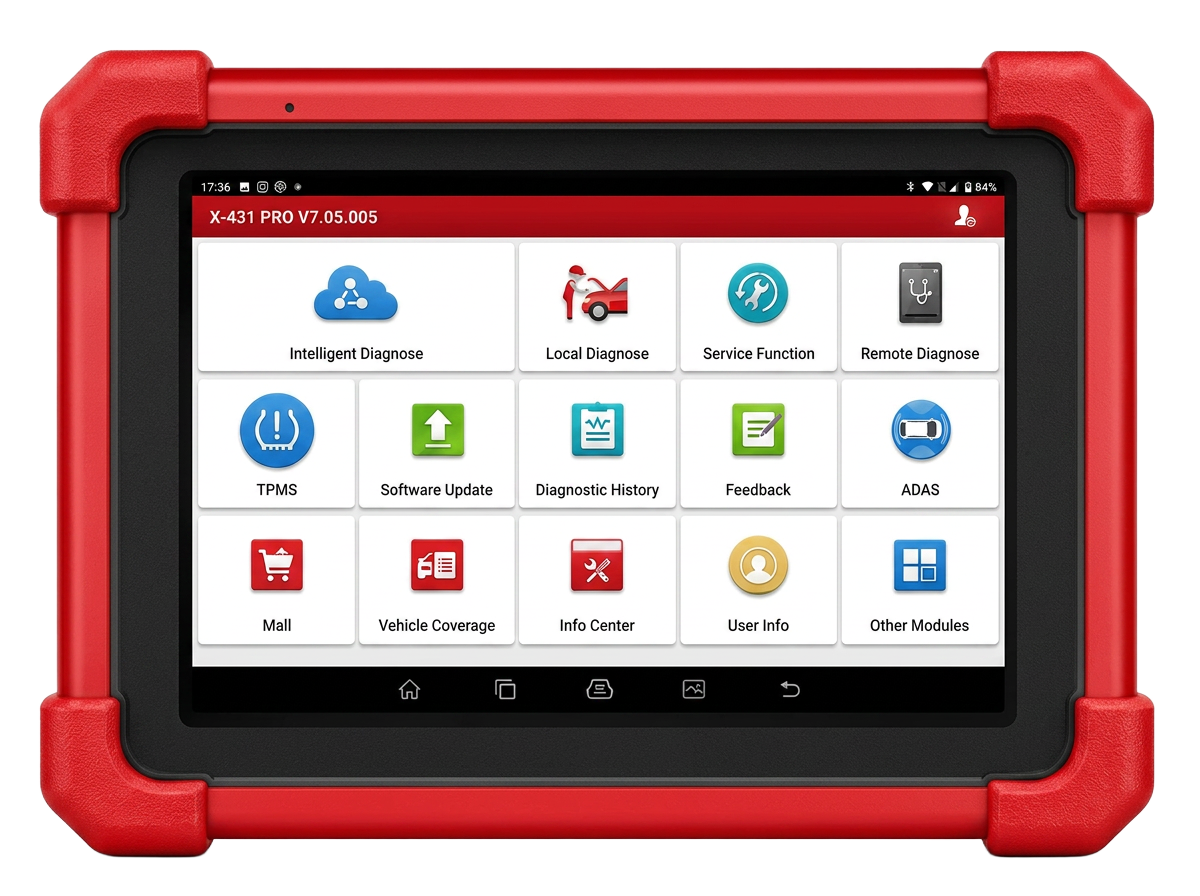
The Launch X431 Pro V5.0, available at MS Auto Tools for Rs 290,000, is built for exactly this kind of work. It covers Toyota, Honda, Suzuki, Kia, Hyundai, and most other brands on Pakistani roads, with full system diagnostics, online coding, and CAN FD and DoIP support for 2023 and newer models. Its wireless VCI connects in seconds, and its large screen makes it practical to carry from car to car across a busy workshop floor. For a workshop running two or three fleet accounts, the Pro V5.0 pays for itself in three to four months of fleet revenue.
Smaller workshops starting with a single fleet of 8 to 10 cars can begin with the Thinkcar Expert 191 at Rs 160,000, which offers the same core coverage with an 8-inch wireless tablet and CAN FD and DoIP support. The important thing is to buy a genuine scanner with a valid warranty and software subscription. Counterfeit scanners sold cheaply online often fail on 2023 and newer cars, lose software updates, and in the worst cases can corrupt a car's ECU during coding. A fleet account is built on trust, and one bricked ECU destroys it. MS Auto Tools sells genuine Launch and Thinkcar scanners with warranty and after-sales support across Pakistan.
Pricing Fleet Contracts in PKR
Fleet pricing works best as a monthly retainer plus parts, not as a per-job rate. A per-job rate creates arguments about every invoice. A retainer creates a predictable relationship.
A practical starting structure for 2026 is a monthly retainer of Rs 3,000 to Rs 5,000 per car, which covers monthly full-system scans, oil service resets, fault code clearing, and minor diagnostics. Parts, oil, filters, and brake pads are billed separately at agreed rates. A 20-car taxi fleet at Rs 4,000 per car is Rs 80,000 a month in retainer income before any parts or repair work. Larger fleets of 50 or more cars can negotiate the retainer down to Rs 2,500 to Rs 3,000 per car, but the volume makes up for it.
Some workshops prefer a per-visit rate instead: Rs 1,500 to Rs 2,500 for a full diagnostic scan and report, plus repair labour at Rs 1,000 to Rs 1,500 per hour. This works well for rental companies whose cars come in irregularly. Whichever model you choose, put it in writing. A one-page agreement listing the retainer, the included services, the parts markup, the payment date, and a 30-day notice period for cancellation protects both sides and looks professional.
How to Win Taxi and Rental Accounts
Fleet owners do not choose workshops from advertisements. They choose workshops other fleet owners recommend, or workshops that approach them with a clear offer. Start with the fleets already around you: the taxi stand near your workshop, the rent-a-car offices in your area, and the ride-hailing drivers who already come to you for repairs.
Approach the owner with a simple proposal: a free full-system scan and health report for three of their cars. This costs you 30 minutes and shows them exactly what you can do. When the report finds a fault they did not know about, such as a weak battery or a stored ABS code, you have demonstrated value before asking for money. Follow up with a written monthly package and a promise of priority service: fleet cars jump the queue, and breakdowns get same-day attention.
Common Mistakes That Lose Fleet Accounts
The fastest way to lose a fleet account is to keep a car too long. Fleet owners measure you in hours, not days. If a simple diagnostic takes two days because you are waiting for a part, the fleet owner will find another workshop. Keep common parts in stock for the fleet's models: oil filters, air filters, brake pads, spark plugs, ignition coils, and ABS sensors for Corolla, Yaris, Swift, and Cultus.
The second mistake is poor communication. A fleet manager does not need a technical lecture. They need to know what is wrong, what it costs, and when the car will be ready. Send a short WhatsApp message with the fault, the price, and the expected completion time before you start the repair. Get approval in writing on WhatsApp before replacing any part above Rs 5,000.
The third mistake is sloppy record-keeping. If the fleet owner asks what you did to a car last month and you cannot answer, trust is gone. A simple register with the car number, date, odometer, and work done is enough. It takes two minutes per car and it is the difference between a professional fleet partner and a roadside mechanic.
For fleet diagnostic equipment, pricing, or a demonstration of the Launch X431 Pro V5.0, contact MS Auto Tools on WhatsApp at +92 300 0678111. We supply workshops across Pakistan with genuine diagnostic tools, key programmers, and ECU equipment, and we can advise on the right setup for your first fleet account.
Frequently Asked Questions
How many cars do I need to start fleet diagnostics?
You can start with a single fleet of 8 to 10 cars. A small taxi fleet of 10 Corollas generates enough regular work to justify a dedicated weekly slot. Start small, prove the system, and grow from there.
What is a fair monthly retainer for fleet diagnostics in Pakistan?
For 2026, Rs 3,000 to Rs 5,000 per car per month is standard for a retainer covering monthly scans, resets, and minor diagnostics, with parts billed separately. Larger fleets of 50 or more cars usually negotiate Rs 2,500 to Rs 3,000 per car.
Which scanner is best for fleet diagnostics work?
The Launch X431 Pro V5.0 at Rs 290,000 is the strongest choice for multi-brand fleets, with full system coverage, CAN FD and DoIP, and fast wireless connection. The Thinkcar Expert 191 at Rs 160,000 is a good starting point for smaller fleets.
How do I keep fleet cars from sitting in my workshop too long?
Keep common parts in stock for the fleet's models, diagnose with a full scan before starting work, and give the fleet manager a time estimate on WhatsApp before the repair begins. Most fleet diagnostic jobs should be finished the same day.
Should I buy a genuine scanner or a cheaper copy for fleet work?
Always buy genuine. Counterfeit scanners often fail on 2023 and newer cars, lose software updates, and can corrupt an ECU during coding. One damaged fleet car costs more than the money saved on a fake scanner. MS Auto Tools sells genuine Launch, Autel, Thinkcar, Xhorse, and OBDSTAR tools with warranty in Pakistan.