
Cooling System Diagnostics: Overheating Faults & Fan Control (2026 Pakistan Guide)
2026-11-07 10:05:28 · by MS Auto Tools
## Introduction
An engine that overheats in Pakistani summer traffic is not just an inconvenience — it is a fast track to a warped cylinder head, a blown head gasket and a repair bill of Rs 150,000 to Rs 300,000. In 2026, with Corolla, Civic, Swift, Sportage and Tucson models all running tighter cooling systems than ever, the difference between a Rs 2,500 thermostat and a Rs 250,000 engine rebuild is how quickly your workshop finds the real fault. This guide covers professional cooling system diagnostics: live temperature data, fan control testing, sensor checks, and fixing the root cause instead of guessing.
## The 5 Most Common Overheating Faults in Pakistani Cars
First, the thermostat stuck closed. This is the number one cause of sudden overheating on Corolla, Civic and Swift models. Coolant cannot reach the radiator, temperature climbs past 110°C within minutes, and the heater blows cold air even as the gauge climbs. A stuck-open thermostat is the opposite problem: the engine never warms up, fuel consumption rises by 10–15%, and the check engine light stores a P0128 code.
Second, electric fan failure. A burnt relay, a failed fan motor or a broken fan control module leaves the fan dead at idle — exactly when the car needs it most in Lahore or Karachi traffic. Fans that run constantly are equally faulty: usually a stuck relay or a bad temperature sensor signal.
Third, a failing water pump. Impeller wear and seal leaks reduce coolant flow gradually. The car overheats only under load — on the motorway or climbing to Murree — while behaving normally in city driving. This intermittent pattern is the hardest to diagnose without live data.
Fourth, a clogged radiator. Scale, rust and debris from years of tap water instead of proper coolant reduce heat transfer, and in Pakistan radiator efficiency drops sharply after 5–6 years of water top-ups. Dust and insects packed between the condenser and radiator cause the same problem and cost nothing to fix.
Fifth, low coolant or air locks. A slow leak from a hose, the radiator cap or the heater core drops the coolant level until air pockets form. Air locks stop circulation entirely and cause wild temperature swings. Always pressure-test the system before condemning any part.
## Reading Live Data: What a Scanner Shows That a Gauge Cannot
Plug a professional scanner into the OBD2 port and watch live coolant temperature while the engine warms up. A healthy car climbs steadily from ambient to about 88°C, pauses briefly as the thermostat opens, then settles between 90°C and 100°C. Temperature stuck below 80°C after 10 minutes of driving means a stuck-open thermostat; climbing past 108°C at idle with the fan off means a fan control fault; swinging up and down by 10°C or more means air in the system or a failing sensor; and a reading of −40°C or a fixed value means a sensor or wiring fault.
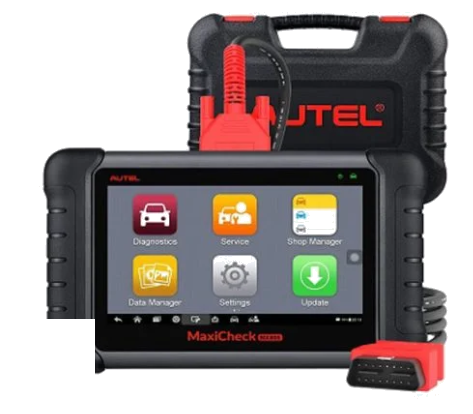
The Autel MaxiCheck MX808S Diagnostic Car Scanner (Rs 148,000) reads live coolant temperature, fan command status and all cooling-related fault codes on Toyota, Honda, Suzuki, Kia and Hyundai models. It also runs active tests — you can command the cooling fan on and off from the scanner and watch whether it actually responds. That single test separates a fan motor fault from a relay or ECU command fault in under a minute. See it here: https://msautotools.com/product.php?slug=autel-maxicheck-mx808s
## Testing Fan Control Step by Step
Start with the engine cold. Connect the scanner, start the engine, and watch live coolant temperature. The fan should stay off until roughly 95–100°C (a Corolla switches on near 97°C, a Civic near 98°C). When the temperature crosses the threshold, the fan should start at low speed, then step up as temperature rises. If the fan never starts, use the scanner's active test to command it on. If it runs on command, the fan motor and wiring are fine — the fault is the temperature sensor signal or the ECU's fan control logic. If it does not run on command either, check the fan relay, fuse and motor supply voltage with a multimeter.
Also test the air conditioning trigger: switching the AC on should force the fan to run immediately on most cars. If the AC works but the fan stays off, the fan control module or relay is the prime suspect. On a Suzuki Swift, the fan relay is a common failure item and costs under Rs 2,000 — but only a scanner test proves it before you replace parts.
## Temperature Sensors: The Rs 3,000 Part That Causes Rs 100,000 of Damage
The engine coolant temperature (ECT) sensor is a small, cheap part with outsized consequences. When it reads wrong — say 60°C when the coolant is actually at 110°C — the ECU never turns the fan on and never warns the driver. The engine cooks silently. Symptoms include hard cold starts, poor fuel economy, black smoke, a fan that runs constantly, or a gauge that reads cold while the engine is clearly hot.
Test it with a scanner: compare the ECT reading with the intake air temperature after the car has sat overnight. Both should be within 2–3°C of each other and close to ambient temperature. If the ECT reads 40°C on a cold morning when the air temperature is 22°C, the sensor is lying. A reading that jumps between 70°C and 120°C in seconds means a wiring or connector fault, often corrosion at the plug from coolant leaks.
If your workshop sees overheating cars every week, you need a scanner that tests fan control properly — not a cheap code reader that only shows fault codes. The Autel MaxiCheck MX808S (Rs 148,000) covers full-system diagnostics, live data and active fan tests on all popular Pakistani cars, and the AUTEL MaxiCheck MX900 (Rs 155,000) adds DoIP and CAN FD support for 2023+ models: https://msautotools.com/product.php?slug=autel-maxicheck-mx900. WhatsApp MS Auto Tools at +92 300 0678111 for genuine tools with warranty and workshop support.
## Pressure Testing, Leaks and When It Means Head Gasket Trouble
A cooling system pressure test is the fastest way to find leaks that no scanner can see. Pump the system to its rated cap pressure — usually 1.1 bar — and watch the gauge for 10 minutes. A drop means a leak: check hoses, the radiator, the water pump weep hole, the heater core and the head gasket area. A radiator cap that cannot hold pressure lets coolant boil at a lower temperature and is a Rs 1,500 fix that many workshops overlook.
Coolant quality matters too. Genuine coolant contains corrosion inhibitors and raises the boiling point to around 125°C under pressure; plain tap water boils at 100°C and corrodes the pump and radiator from the inside. A Rs 3,000 coolant change beats a Rs 60,000 radiator replacement.
If the car overheats, loses coolant with no visible leak, blows white smoke, or shows milky oil on the dipstick, suspect the head gasket. Confirm with a chemical block test or by watching for bubbles in the coolant reservoir with the engine running. A scanner helps here too: misfire codes on one or two cylinders combined with rapid coolant loss point straight at a gasket failure. Never just top up the coolant and send the customer away — a leaking head gasket will strand them within days and the repair cost triples once the head warps.
## Genuine Tools Warning: Fake Scanners Give Fake Temperatures
A counterfeit scanner is dangerous precisely because it looks like it works. Fake Autel and Launch units sold online at half price often show frozen or invented live data — a coolant temperature reading that never changes, fan commands that do nothing, and fault codes that are simply wrong. A workshop that trusts fake data will replace the wrong parts and miss a failing fan. MS Auto Tools sells only genuine Autel, Launch, Xhorse, Thinkcar, OBDSTAR and XTOOL equipment with official warranty and software updates. If a deal looks too good to be true, it is a fake — and it can cost your customer an engine.
## A Workshop Checklist for Every Overheating Car
One, read fault codes and live coolant temperature before touching anything. Two, watch the warm-up curve and note where the thermostat opens. Three, command the fan on and off with the scanner and confirm both speeds. Four, pressure-test the system and check the radiator cap. Five, inspect coolant colour — rusty or oily coolant tells its own story. Six, test the ECT sensor against a cold-soak reading. Seven, only then replace parts, and always re-test after the repair with a full warm-up and a road test. A workshop that follows this checklist fixes overheating cars on the first visit — and first-visit fixes are what build a reputation in any Pakistani city.
## FAQ
Why does my car overheat only in traffic, not on the motorway?
At speed, airflow through the radiator cools the engine even without the fan. In traffic there is no airflow, so the electric fan does all the work. If the fan, its relay or the temperature sensor fails, the car overheats only at idle and in slow traffic — a scanner active test finds the fault in a minute.
What temperature should my Corolla or Civic run at?
Most Pakistani-market Corolla and Civic models run between 88°C and 100°C, with the fan switching on near 97–98°C. Brief peaks to 105°C in heavy summer traffic are normal; sustained readings above 110°C mean a fault that needs attention now.
Can a bad thermostat cause the check engine light?
Yes. A thermostat stuck open keeps the engine too cold and stores code P0128. A thermostat stuck closed usually triggers an over-temperature warning and, on many models, a P0217 engine over-temperature code.
How do I know if my cooling fan is working?
Let the engine idle with the AC off and watch the temperature. The fan should start by the time coolant reaches about 97–100°C. If it does not, use a scanner's active test to command the fan on — if it runs on command, the fault is the sensor or control side; if it does not, check the relay, fuse and fan motor.
What scanner do I need for cooling system diagnostics?
You need a scanner with live data and active tests, not just code reading. The Autel MaxiCheck MX808S (Rs 148,000) covers fan control tests, live coolant temperature and full-system diagnostics on Pakistani cars, and the AUTEL MaxiCheck MX900 (Rs 155,000) adds DoIP and CAN FD for newer models. Both are available genuine with warranty from MS Auto Tools.
## Conclusion
Overheating is one of the most common — and most expensive — problems Pakistani workshops see, especially from May to September. It is also one of the most diagnosable: live coolant temperature, a fan active test, a pressure test and a cold-soak sensor check will find the fault on the first visit in almost every case. The workshops that win this work test before they replace parts, and the tool that makes that possible is a genuine professional scanner with live data and active tests.
Equip your workshop for cooling system season. The Autel MaxiCheck MX808S (Rs 148,000) and AUTEL MaxiCheck MX900 (Rs 155,000) are in stock at MS Auto Tools — genuine, with warranty and full workshop support. Order or ask anything on WhatsApp: +92 300 0678111. Visit https://msautotools.com/product.php?slug=autel-maxicheck-mx808s to see the MX808S, or browse the full scanner range at https://msautotools.com.