
Car AC Not Cooling: Compressor, Pressure & Leak Diagnostics (2026 Pakistan Guide)
2026-11-27 14:02:17 · by MS Auto Tools
Car AC not cooling is the most common complaint Pakistani workshops hear every summer — and the fix is rarely guesswork. In most cases the cause is one of four things: low refrigerant from a leak, a weak or failed compressor, a blocked condenser or expansion valve, or an electrical fault in the AC control circuit. A proper diagnosis with manifold gauges, a scan tool and a leak detector finds the real fault in under an hour, so the customer pays for one repair instead of three. This guide walks through the full diagnostic workflow used by professional workshops in 2026, with real pressure readings, Pakistani car examples and current tool prices.
What "Not Cooling" Actually Means
Before touching a gauge, define the symptom precisely, because "AC not cooling" covers at least five different faults. Ask the customer three questions: does the air start cold and then turn warm, does it never get cold at all, is the cooling weak only in traffic or at idle, does the compressor clutch engage, and is there any unusual noise or smell? A Corolla that blows cold on the motorway but warm in Lahore traffic usually has a condenser airflow problem — a weak fan or a condenser clogged with dust and insects. A Civic that never cools at all usually has no refrigerant left or a dead compressor clutch. A Swift that cools for ten minutes and then stops often has a freezing evaporator caused by a faulty thermistor or a low charge. Write the symptom down before you start, because the pressure readings only make sense against it.
The 60-Second Visual Check
Start with the engine running and the AC set to maximum cooling, blower on high, recirculation on. First, look at the compressor: the clutch hub in the centre of the pulley should be spinning with the belt. If the outer pulley spins but the hub is still, the clutch is not engaging — check the fuse, the relay and the pressure switch before condemning the compressor. Second, feel the two aluminium pipes at the firewall: the thick low-pressure pipe should be cold and sweating, the thin high-pressure pipe should be warm to hot. If both are at ambient temperature, the system is either empty or the compressor is not pumping. Third, look at the condenser in front of the radiator: bent fins, a thick layer of dust or a plastic bag stuck to it will kill cooling at idle. Fourth, check the cabin filter behind the glovebox on a Corolla, Civic or Sportage — a black, clogged filter alone can cut airflow by half and make a healthy AC feel weak. Fifth, listen: a rattling compressor, a hissing sound behind the dashboard or a belt squeal on engagement each point to a different fault. This visual check takes one minute and rules out a surprising number of jobs.
Reading the Gauges: What Normal Pressure Looks Like
A manifold gauge set is the stethoscope of AC work, and every reading tells a story. With the engine at 1,500 rpm, AC on maximum and ambient temperature around 35 to 40 degrees Celsius — a normal Pakistani summer day — a healthy R134a system shows roughly 25 to 40 psi on the low side and 150 to 250 psi on the high side. On R1234yf cars such as newer Sportage and Tucson variants, the numbers are similar but the fittings and the machine are different, so never mix the two refrigerants or their service equipment.
Low on both sides, around 10 psi low and 80 psi high, means the system is undercharged — almost always a leak, because refrigerant does not get used up. High on the low side and low on the high side, for example 70 psi low and 120 psi high, means the compressor is weak or its internal valves have failed; it is spinning but not pumping. High on both sides, such as 60 psi low and 350 psi high, points to poor condenser cooling, overcharge or air and moisture inside the system. A low side that drops into vacuum and then recovers in cycles means moisture freezing at the expansion valve — the system needs evacuation and a new receiver-drier. Record both readings with the ambient temperature and engine rpm, because a reading without context is just a number.
Leak Detection: Finding Where the Gas Went
A system that needs topping up every summer has a leak, and topping it up without finding the leak is the most expensive way to do AC work — for the workshop's reputation as well as the customer's wallet. Start with the cheap checks: look for oily residue at every joint, hose crimp and compressor seal, because refrigerant carries compressor oil with it and the oil stain marks the leak. Check the service port caps, the condenser bottom corners where road stones hit, and the evaporator drain under the car — an oily drip from the drain usually means an evaporator leak.
For confirmation, use an electronic leak detector around each joint, or inject UV dye and recheck with a UV lamp after a few days of driving. Nitrogen pressure testing is the most reliable method for a stubborn leak: charge the empty system with dry nitrogen at 150 psi, spray soapy water on the joints, and watch for bubbles. Common leak points on Pakistani cars are the condenser on the Corolla and Civic after stone damage, the compressor shaft seal on high-mileage Swifts, the O-rings at the firewall on the Sportage, and the evaporator on any car where the drain has been blocked for years. On a 2026 workshop, a nitrogen test plus dye costs the customer roughly Rs 1,500 to Rs 3,000 and saves them from paying for a second gas charge a month later.
Compressor Diagnostics: Repair, Replace or Rebuild
The compressor is the most expensive part of the AC system, so diagnose it properly before quoting a replacement. With the gauges connected, watch the readings when the clutch engages: a healthy compressor pulls the low side down and pushes the high side up within seconds. If the pressures barely move, the compressor is worn out. Check the clutch air gap with a feeler gauge — excessive gap causes intermittent engagement, especially when the compressor is hot, and a shim kit often fixes it for a few hundred rupees instead of a new compressor. Measure the clutch coil resistance, usually 3 to 5 ohms; an open circuit means a dead coil, and a coil that reads fine cold but fails hot is a classic intermittent fault.
Listen for internal noise: a rattling or grinding compressor with metal particles in the oil means the system must be flushed, the receiver-drier and expansion valve replaced, and the condenser checked for debris — fitting a new compressor onto a contaminated system kills the new compressor within weeks. Replacement compressor prices in Pakistan in 2026 range from about Rs 25,000 for a reconditioned unit for a Swift or Cultus to Rs 60,000 to Rs 120,000 for a new genuine compressor for a Corolla, Civic, Sportage or Tucson, with labour of roughly Rs 5,000 to Rs 10,000 depending on access. Always replace the receiver-drier at the same time, and always evacuate the system for at least 30 minutes before charging.
Electrical and Control Faults the Scanner Finds
Not every AC failure is mechanical. Modern cars control the compressor through the engine control unit, and a scan tool reads faults the gauges cannot see. A faulty evaporator temperature sensor, a failed ambient temperature sensor, a high-pressure switch stuck open or a body control module that never sends the AC request will all leave the compressor silent while the gauges look perfect. On a Corolla Cross, Sportage or Tucson, the HVAC module also stores blend-door and blower faults that feel like weak cooling but are actually an air-distribution problem.
This is where a diagnostic scanner earns its keep in AC season: it reads live data such as evaporator temperature, refrigerant pressure sensor voltage, compressor duty cycle and fan speed request, and it can command the compressor clutch and cooling fans on for testing. A Thinkdiag 2 at Rs 65,000 or an Autel MaxiCheck MX808S at Rs 148,000 both cover AC system diagnostics, actuator tests and live data on the cars Pakistani workshops see every day. If the scanner shows the ECU is requesting the compressor but the clutch never engages, the fault is in the relay, wiring or clutch itself. If the ECU never requests it, look at the pressure sensor, the temperature sensors and the AC switch input first.
The Right Way to Recharge: Evacuate, Then Charge by Weight
The single most common workshop mistake in AC work is charging by gauge pressure alone. The correct method is to recover the old refrigerant, pull a deep vacuum for at least 30 minutes to remove air and moisture, hold the vacuum for 10 minutes to confirm there is no leak, then charge the exact weight printed on the under-bonnet label — typically 450 to 550 grams for a Corolla or Civic, 500 to 650 grams for a Sportage or Tucson. Charging by pressure alone overfills the system in cool weather and underfills it in hot weather, and an overcharged system cools worse than a correctly charged one while straining the compressor.
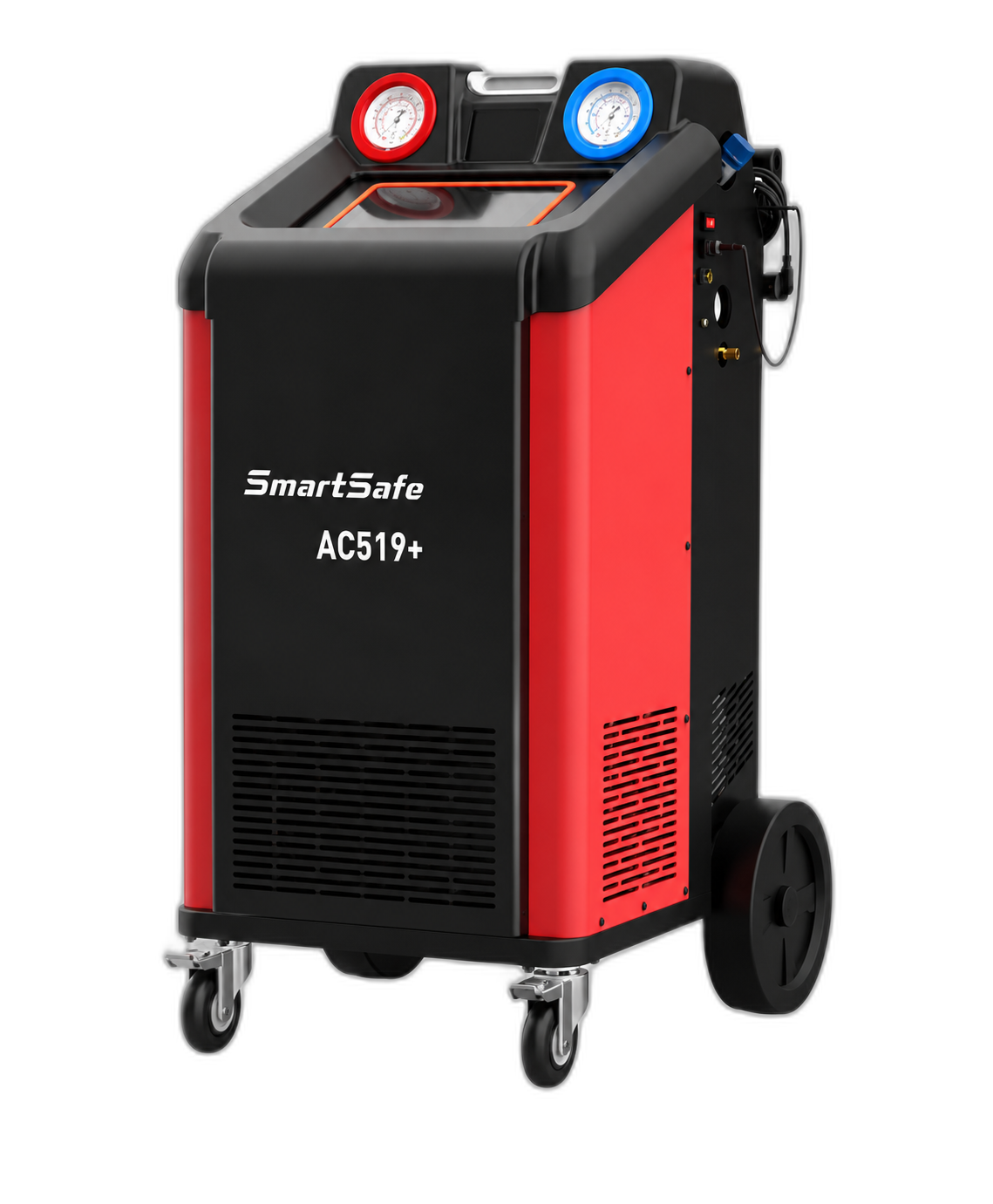
That is why a proper AC gas machine has become standard equipment in professional workshops. The SmartSafe AC519+ AC Gas Machine, available at MS Auto Tools for Rs 10,500, handles recovery, vacuuming and charging in one unit, so a small workshop can do a by-the-book recharge without investing in a full automatic station. For workshops doing five or more AC jobs a week, the machine pays for itself in a single summer season through faster jobs and fewer comebacks. Whatever equipment you use, always add the correct PAG oil quantity when a component has been replaced, and never vent refrigerant to the atmosphere — recover it.
Common AC Faults on Popular Pakistani Cars
Different cars fail in different places, and knowing the pattern saves diagnostic time. The Toyota Corolla (2014 to 2024) most often suffers condenser stone damage and evaporator leaks, and its compressor clutch relay is a known weak point. The Honda Civic (2016 onwards) is prone to condenser leaks at the lower corners and to evaporator temperature sensor faults that freeze the evaporator. The Suzuki Swift commonly loses gas through the compressor shaft seal after 80,000 kilometres, and its cabin filter is often neglected until airflow collapses. The Kia Sportage and Hyundai Tucson share compressor control-valve failures that cause intermittent cooling — the compressor runs but cooling fades, and the fix is a control valve or a compressor replacement rather than another gas top-up. The Toyota Fortuner and Hilux diesel models put heavy load on the condenser at idle in traffic, so fan and condenser condition matter more than on a small car. Keep these patterns in mind, but always verify with gauges and a scan tool — pattern recognition guides the diagnosis, it never replaces it.
What an AC Repair Should Cost in 2026
Customers ask for a price before they ask for a diagnosis, so here are realistic 2026 ranges for Pakistani workshops. A leak check with nitrogen and dye costs roughly Rs 1,500 to Rs 3,000. A full service — recovery, vacuum, recharge by weight and a cabin filter — runs about Rs 4,000 to Rs 8,000 depending on the refrigerant quantity. An O-ring or hose replacement with a recharge is typically Rs 8,000 to Rs 15,000. A condenser replacement with a recharge is usually Rs 20,000 to Rs 40,000. A compressor replacement, including drier, oil and gas, generally falls between Rs 45,000 and Rs 130,000 depending on the car and whether the compressor is new genuine, new aftermarket or reconditioned. Always quote the diagnosis separately from the repair, and always show the customer the gauge readings or the leak detector result — a customer who sees the evidence approves the repair without haggling.
Avoid Counterfeit AC Parts and Tools
AC work is one area where counterfeit parts cause real damage. Fake compressors with poor internal tolerances shed metal into the system within months, and counterfeit refrigerant — sometimes sold as R134a but mixed with flammable hydrocarbons — is a genuine safety risk in a workshop. The same warning applies to diagnostic tools: counterfeit scanners often cannot read AC live data or run actuator tests, and cloned AC machines may charge the wrong quantity. Buy genuine tools and parts from an authorised seller with warranty, and keep the invoice — MS Auto Tools supplies genuine Autel, Launch, Xhorse, Thinkcar and SmartSafe equipment with warranty across Pakistan, so the tool you diagnose with is as reliable as the repair you sell.
Need the right AC diagnostic equipment for your workshop? The SmartSafe AC519+ AC Gas Machine is available at MS Auto Tools for Rs 10,500, and the Thinkdiag 2 scanner at Rs 65,000 covers AC live data and actuator tests on Corolla, Civic, Swift, Sportage and Tucson. Message MS Auto Tools on WhatsApp at +92 300 0678111 for current prices, availability and delivery anywhere in Pakistan.
Frequently Asked Questions
Why does my car AC cool on the highway but not in traffic? The condenser relies on airflow, and at idle it depends entirely on the cooling fan. A weak fan, a dirty condenser or low refrigerant all show up first in traffic. Check the fan operation, clean the condenser fins and verify the charge before replacing parts.
How often should car AC gas be topped up? Never, if the system is healthy — refrigerant circulates in a sealed loop and is not consumed. If your AC needs gas every summer, there is a leak, and it should be found with a nitrogen test or UV dye instead of another top-up.
How much does a car AC gas refill cost in Pakistan in 2026? A proper service with recovery, vacuum and recharge by weight typically costs Rs 4,000 to Rs 8,000 for a Corolla, Civic or Swift, and slightly more for a Sportage, Tucson or Fortuner because they hold more refrigerant. A cheap top-up without vacuuming costs less but leaves moisture in the system.
Can a faulty AC compressor be repaired instead of replaced? Sometimes. A worn clutch, a failed coil or a leaking shaft seal can be repaired, and a control valve can be replaced on some Sportage and Tucson compressors. But a compressor with internal wear or metal debris must be replaced, and the system flushed, or the new compressor will fail quickly.
Which scanner is best for AC diagnostics in a Pakistani workshop? Any scanner with AC live data and actuator tests will do the job — the Thinkdiag 2 at Rs 65,000 is the budget pick, while the Autel MaxiCheck MX808S at Rs 148,000 adds bi-directional control and wider coverage. The key features are refrigerant pressure readings, compressor duty cycle and the ability to command the clutch and fans.
Is it safe to use cheap or unknown-brand AC gas? No. Counterfeit refrigerant can contain flammable gases and can damage the compressor and the recovery machine. Always use branded R134a or R1234yf from a trusted supplier, and charge by the weight on the car's label.
If your workshop sees AC complaints every day this summer, the right diagnostic routine turns a frustrating job into a profitable one: check the symptom, read the gauges, find the leak, test the compressor and charge by weight. For genuine AC tools, scanners and the SmartSafe AC519+ gas machine, contact MS Auto Tools on WhatsApp at +92 300 0678111 — genuine products, warranty and delivery across Pakistan.