Battery Registration & BMS Reset in Pakistan: Why Your New Car Battery Needs Coding (2026 Guide)
2026-10-19 17:58:15 · by MS Auto Tools
Battery Registration and BMS Reset: Why Your New Car Battery Needs Coding in 2026
Replaced your car battery but the new one keeps dying, the start-stop system stopped working, or warning lights appeared on the dashboard? The battery itself is fine — the problem is that your car does not know it has a new battery. Modern cars use a Battery Management System (BMS) that tracks the age, capacity and health of the battery, and after every replacement it must be told a new battery is fitted. This process is called battery registration or BMS reset. In this 2026 Pakistan guide, we explain which cars need it, what happens if you skip it, which tools perform the reset, and what it costs.
What Is Battery Registration (BMS Reset)?
A Battery Management System is software in the car's ECU that constantly monitors the battery's state of charge, state of health, temperature and charging cycles. Based on this data, the alternator adjusts how aggressively it charges the battery — an old battery gets a higher charge rate, a new one gets a gentler, controlled rate.
When you install a new battery without registering it, the BMS still thinks the old, tired battery is connected. It continues to apply the old charging strategy, which causes three problems: the new battery gets overcharged (shortening its life by 2–3 years), start-stop and regenerative functions behave erratically, and the ECU can log fault codes in the battery module. Battery registration simply tells the BMS: a new battery is fitted, here are its type and capacity — start the charging strategy from zero again.
This applies to AGM, EFB and enhanced flooded batteries used in most cars built after 2010, including Pakistani-market Corolla, Civic, Swift, Sportage and Tucson models with start-stop systems.
Which Cars in Pakistan Need Battery Registration?
Not every car needs it. If your car is a 2010–2020 model without start-stop, a straightforward battery swap usually works fine. But battery registration is REQUIRED or strongly recommended for:
- Cars with start-stop (idle stop) systems — new Honda City, Toyota Corolla Grande, Kia Sportage and Hyundai Tucson variants fitted with AGM batteries.
- Cars with Intelligent Battery Sensors (IBS) on the negative terminal — BMW, Mercedes-Benz, Audi, VW and newer Toyota/Honda models.
- Any car where the owner manual says "battery must be registered after replacement" — most German cars, and increasingly Japanese and Korean models.
- Cars with regenerative braking or 48V mild-hybrid systems.
A quick rule for workshops: if you see a small sensor box clipped onto the negative battery terminal, that car needs registration after a battery swap. Missing it means the customer will be back within weeks complaining the new battery is "weak."
What Happens If You Skip Battery Registration?
Skipping the reset is one of the most expensive 10-minute mistakes a workshop can make. Here is what happens when a new battery runs on an old BMS profile:
1. Shortened battery life: Overcharging cooks a new AGM battery. A battery that should last 4–5 years can fail in 18–24 months — and the customer blames your workshop or the battery brand.
2. Dead start-stop system: The BMS refuses to activate start-stop because it believes the battery is still weak, so the fuel-saving feature silently stops working.
3. Warning lights and fault codes: The ECU stores codes like "battery adaptation required," and on some cars an airbag, ABS or EPS warning can appear because low-voltage events confuse other modules.
4. Parasitic drain: The energy management system may never let the car sleep properly, draining the new battery overnight.
In short: a proper battery swap in 2026 is two jobs — the physical replacement AND the electronic registration. Charge for both.
How Battery Registration Works: The 5-Minute Workshop Procedure
The procedure itself is simple once you have the right scanner. Here is the standard workflow:
1. Note the battery specs: type (AGM/EFB/flooded), capacity in Ah, and CCA. The replacement battery should match the car's specified type — never downgrade an AGM car to a flooded battery.
2. Install the battery and keep memory saver power if you want to avoid losing radio codes and adaptations (optional but professional).
3. Connect the diagnostic scanner to the OBD-II port and select the battery module (usually under Body → Battery Management / Energy Management).
4. Select "Battery Registration" or "Battery Replacement" and enter the new battery's specifications — Ah rating, type and serial/code if required.
5. Run the function. The scanner confirms registration success. Clear any stored battery-related codes and verify charging voltage (healthy range: 13.8–14.4V running).
6. Test start-stop function and road-test the car briefly.
The whole electronic part takes under five minutes — but only if your scanner supports battery registration for that make. Cheap generic OBD readers only read engine codes and cannot touch the BMS at all.
Which Tools Do Battery Registration? (And Which Ones Cannot)
Battery registration is a special function, not basic OBD-II. You need a full-system scanner with service functions. The tools below, all available as genuine units from MS Auto Tools, support battery registration and BMS reset:
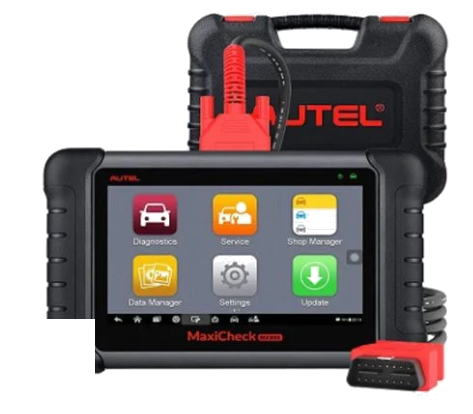
- Autel MaxiCheck MX808S (Rs 148,000) — an excellent mid-range all-system scanner with full service functions including battery registration, oil reset, EPB, SAS and DPF. Ideal for general workshops that service Corolla, Civic, Swift, Sportage and Tucson daily.
- Launch X431 Pro V5.0 (Rs 290,000) — a flagship-level tool with wide vehicle coverage, CAN FD and DoIP support, full battery registration plus advanced functions for workshops handling European and newer models.
Beware of cheap clones sold on marketplaces: counterfeit Autel and Launch units are common in Pakistan. They often fail on special functions like battery registration, freeze mid-write, or in the worst case corrupt the BMS data. A bricked body control module costs far more than a genuine tool. MS Auto Tools supplies genuine Autel, Launch, Xhorse, Thinkcar, OBDSTAR and XTOOL scanners with warranty.
MID-ARTICLE CTA: Running a workshop in Pakistan? Add battery registration to every battery job and stop losing customers to dying new batteries. WhatsApp MS Auto Tools at +92 300 0678111 — we will recommend the right genuine scanner for the cars you service most.
How Much Should a Workshop Charge for Battery Registration in Pakistan (2026)?
Battery registration is a genuine value-added service, and workshops should price it separately from the battery sale. Current market rates in Pakistan:
- Battery registration / BMS reset alone: Rs 1,500–3,000 depending on the car and city.
- Battery supply + fitting + registration bundle: Rs 2,000–4,000 labour margin on top of the battery price.
- German cars (BMW/Mercedes/Audi) with IBS: Rs 3,000–5,000 — these need longer adaptation checks and customer education.
For a workshop doing just 10 battery jobs a month, registration adds Rs 15,000–30,000 in pure service income — the scanner pays for itself quickly. Always show the customer the "registration successful" confirmation on the scanner screen; it builds trust and justifies the charge.
Battery Registration vs Battery Coding: Are They the Same?
Workshops often confuse these two terms. Battery REGISTRATION tells the BMS that a new battery of the same spec has been fitted — resetting age and charge-history counters. Battery CODING (or "programming") is needed when you change the battery's TYPE or CAPACITY — for example, upgrading from a 60Ah flooded battery to a 70Ah AGM unit. Coding writes the new capacity and type into the ECU; registration just resets the counters.
Most Pakistani-market battery swaps are like-for-like replacements, so registration is enough. But if the customer upgrades the battery spec, you must code the new values — otherwise the alternator charges the new battery using the old battery's profile, defeating the purpose.
Conclusion: Stop Skipping the Reset
Battery registration is no longer optional workshop knowledge — it is part of every modern battery replacement. It takes five minutes with a proper scanner, protects the customer's new battery, keeps start-stop working, and adds real service revenue to your workshop. If your scanner cannot do battery registration, it is time to upgrade.
FAQs
Q: Does every car need battery registration after a battery change?
A: No. Older cars without a battery management system (most pre-2010 models without start-stop) do not need it. But any car with an intelligent battery sensor on the negative terminal, start-stop, or an AGM/EFB battery does — which includes most 2016+ Corolla, Civic, Sportage and Tucson variants in Pakistan.
Q: Can I register a battery with a cheap Rs 3,000 OBD reader?
A: No. Basic OBD-II readers only read engine fault codes. Battery registration is a special service function that requires a full-system scanner such as the Autel MaxiCheck MX808S or Launch X431 Pro V5.0.
Q: What happens if I fit a new battery without registration?
A: The BMS keeps using the old battery's charging profile, overcharging the new battery. Expect shortened battery life (18–24 months instead of 4–5 years), a dead start-stop system, warning lights, and possible parasitic drain.
Q: AGM vs EFB vs flooded — does registration differ?
A: The registration function is the same, but you must select the correct battery type in the scanner. Never fit a cheaper flooded battery in a car specified for AGM — the charging voltages are different and you can damage the battery and the car's electronics.
Q: How long does battery registration take?
A: The electronic procedure takes 3–5 minutes with the right tool. Always verify success on the scanner screen and check charging voltage (13.8–14.4V) afterwards.
Q: Where can I buy a genuine scanner with battery registration in Pakistan?
A: MS Auto Tools (msautotools.com) supplies genuine Autel, Launch, Thinkcar, OBDSTAR, XTOOL and Xhorse tools with warranty. For battery registration, the Autel MaxiCheck MX808S (Rs 148,000) is the popular workshop choice. WhatsApp +92 300 0678111 for advice and current pricing.
CLOSING CTA: Ready to add battery registration to your workshop's services? Get a genuine Autel or Launch scanner from MS Auto Tools with warranty and local support. WhatsApp us now at +92 300 0678111 — tell us which cars you service and we will pick the right tool for you.